
Click-Lock vs. Glue-Down Vinyl Plank Flooring: Which Is Better for Toronto Homes?
When choosing vinyl plank flooring for a Toronto home, condo, basement, or commercial property, one of the most important decisions is the installation method.
The two most common options are click-lock vinyl plank flooring and glue-down vinyl plank flooring.
Both can provide attractive wood-look flooring, good everyday durability, and practical maintenance. However, they behave differently after installation and have different requirements for subfloor preparation, repairs, and long-term performance.
For many residential renovations, quality click-lock vinyl plank flooring is a practical option. For larger commercial spaces and areas with demanding foot traffic, properly specified glue-down vinyl plank flooring is often preferable.
Neither method is automatically better for every property.
This guide compares their advantages, disadvantages, costs, thickness requirements, and suitability for Toronto houses, condos, and businesses.

What Is Click-Lock Vinyl Plank Flooring?
Click-lock vinyl plank flooring uses interlocking edges that connect the individual planks without bonding them directly to the subfloor.
The connected flooring forms a floating installation, meaning it rests on the prepared substrate while allowing the movement specified by the manufacturer.
Many click-lock products use rigid-core construction, including SPC (stone plastic composite) or WPC (wood plastic composite).
Some products have attached underlayment, while others require a separate approved underlayment.
Advantages of Click-Lock Vinyl Plank Flooring
Faster installation: There is no full-spread adhesive application or associated curing period.
Suitable for many homes: Click-lock products are available for bedrooms, living rooms, basements, and other approved residential spaces.
Potentially lower installation costs: Straightforward floating installations may require less labour than glue-down systems.
Convenient renovations: Certain products can be installed over existing flooring when the manufacturer permits it.
Underfoot comfort: Depending on the core and underlayment, some floating products offer a slightly cushioned feel.
Disadvantages of Click-Lock Vinyl Plank Flooring
The locking joints can be vulnerable to damage when the subfloor is uneven or the floor experiences loads outside the product's specifications.
Floating installations also require appropriate expansion spaces and may need transition breaks between large areas.
Heavy fixed cabinetry, unsuitable rolling loads, and incorrect underlayment can cause problems.
For this reason, the product should be selected according to the room and expected use—not simply because it is easy to install.
What Is Glue-Down Vinyl Plank Flooring?
Glue-down vinyl plank flooring uses individual planks bonded to a prepared substrate with manufacturer-approved flooring adhesive.
Unlike click-lock flooring, the planks do not rely on interlocking edges to remain connected.
Glue-down vinyl plank flooring is widely used in commercial interiors, although it can also be an excellent option for houses, condos, and residential renovations.
Advantages of Glue-Down Vinyl Plank Flooring
Stable bonded installation: Suitable systems perform well in many larger commercial spaces.
Commercial suitability: Many glue-down products are designed for demanding foot traffic and approved rolling loads.
Low-profile construction: Thin products can be useful where existing doors and transitions limit finished floor height.
Individual plank replacement: Damaged planks can often be removed and replaced without dismantling an entire floating floor.
Design flexibility: Straight-plank and herringbone patterns are available using compatible flooring products.
Disadvantages of Glue-Down Vinyl Plank Flooring
Glue-down vinyl plank flooring requires more detailed substrate preparation.
Because the planks are relatively thin and directly bonded to the floor, bumps, cracks, uneven patches, and adhesive residue can affect the finished appearance.
Installation also involves adhesive application, required working times, rolling, and curing instructions.
Removing an entire glue-down floor in a future renovation can be more labour-intensive than removing floating click-lock flooring.
Click-Lock vs. Glue-Down Vinyl Plank Flooring: Side-by-Side Comparison
Feature | Click-Lock Vinyl Plank Flooring | Glue-Down Vinyl Plank Flooring |
Installation | Floating, interlocking planks | Planks bonded with adhesive |
Common thickness | Often 5–8 mm or more | Commonly 3–5 mm |
Installation labour | Often lower | Typically higher |
Subfloor preparation | Must meet flatness and stability requirements | Requires very smooth, properly prepared substrate |
Large commercial areas | Product-dependent | Often preferable |
Heavy rolling loads | Requires suitable product approval | Many commercial-rated options |
Individual plank repairs | May require removing connected planks | Often possible to replace locally |
Complete floor removal | Generally easier | Usually more labour-intensive |
Underlayment | Attached or approved separate system | Generally direct bond or approved acoustic system |
Best applications | Many residential projects | Commercial and selected residential projects |
The comparison reflects common installation characteristics. Actual performance depends on the manufacturer, product construction, substrate, and installation quality.
1. Which Vinyl Plank Flooring Is More Durable?
Neither installation method guarantees better overall durability.
There are two different factors to consider: the durability of the flooring surface and the stability of the installed system.
Surface Durability
Scratch resistance, abrasion resistance, indentation performance, and wear depend on the flooring product itself.
A high-quality commercial-rated click-lock vinyl plank flooring product may outperform a lower-quality glue-down product.
Similarly, a well-manufactured glue-down product may offer excellent performance in busy commercial environments.
The wear layer, protective finish, core construction, and manufacturer specifications matter more than the installation label alone.
Installation Stability
A glue-down installation can offer advantages in large or heavily used spaces because the flooring is bonded to the substrate.
Click-lock flooring relies on the integrity of its locking joints and must be able to accommodate the movement allowed by the manufacturer.
For commercial corridors, retail stores, and large open areas, Parqueteam generally recommends evaluating commercial-rated glue-down vinyl plank flooring first.
For ordinary residential use, quality click-lock flooring may perform very well when correctly installed.
2. Which Vinyl Plank Flooring Thickness Is Better?
Thickness is an important consideration, but click-lock and glue-down vinyl plank flooring cannot be compared using thickness alone.
Click-Lock Vinyl Plank Flooring Thickness
At Parqueteam Hardwood Flooring, we generally favour quality 8 mm click-lock vinyl plank flooring for suitable residential projects.
A well-manufactured 7 mm product can also be a reasonable choice.
Products thinner than 8 mm deserve particular attention to the strength of the locking system, subfloor conditions, and manufacturer specifications.
However, a thinner product is not automatically defective, and an 8 mm product is not automatically superior.
A strong locking mechanism and reliable construction are essential.
Glue-Down Vinyl Plank Flooring Thickness
Glue-down vinyl plank flooring commonly comes in thinner formats, including 3 mm and 5 mm.
These products can perform reliably because they do not rely on a click-lock mechanism.
A properly specified 3 mm commercial glue-down product may therefore be more suitable for a demanding project than a thicker floating product that is not approved for the same conditions.
The correct comparison should consider the complete product and installation system.
3. Which Vinyl Plank Flooring Is Better for Toronto Condos?
Both click-lock and glue-down vinyl plank flooring can be suitable for Toronto condos.
However, the condominium corporation's renovation and acoustic requirements must be reviewed before choosing an installation method.
Many Toronto condo floors have concrete subfloors and minimum sound-control requirements.
When Click-Lock Vinyl Plank Flooring Makes Sense
Click-lock vinyl plank flooring may be appropriate when:
The building permits floating flooring.
The chosen underlayment or flooring assembly meets acoustic requirements.
The concrete is properly prepared.
The flooring product is approved for the installation area.
When Glue-Down Vinyl Plank Flooring Makes Sense
Glue-down vinyl plank flooring can be appropriate when the building permits the selected bonded flooring assembly.
Where an acoustic membrane is required, the flooring, membrane, and adhesives must be compatible and approved together.
It is important not to assume that gluing vinyl plank flooring directly to concrete will automatically satisfy condo sound-control requirements.
The best condo flooring installation method is the one that meets both the manufacturer's instructions and the building's rules.
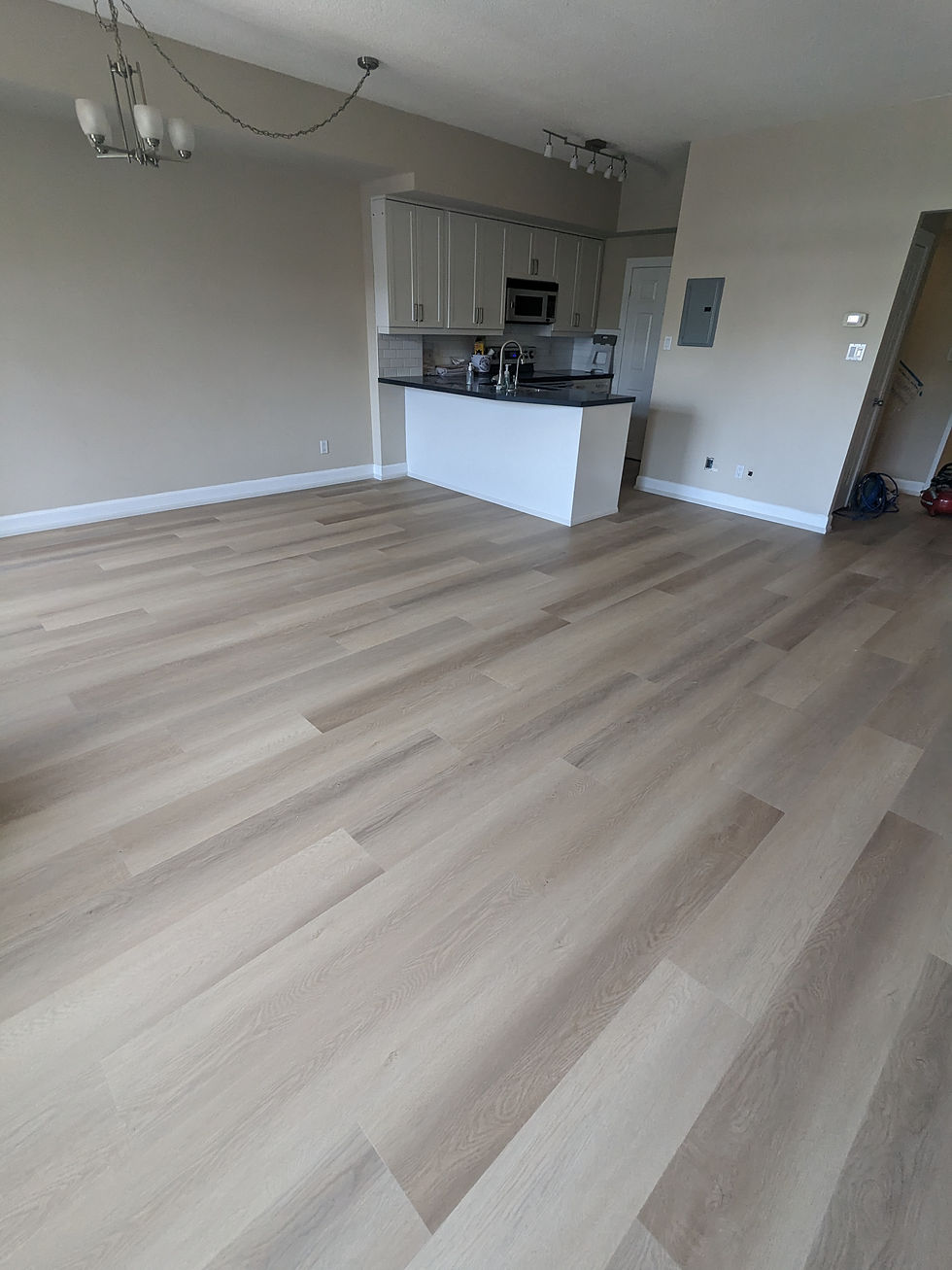
4. Which Vinyl Plank Flooring Is Better for Basements?
Vinyl plank flooring is popular for Toronto basements floors because many products have water-resistant or waterproof plank construction.
However, neither click-lock nor glue-down vinyl plank flooring solves an existing basement moisture problem.
Click-Lock Vinyl Plank Flooring in Basements
Floating vinyl plank flooring can be practical for suitable basement renovations.
The manufacturer may require a particular underlayment or moisture-control layer over concrete.
The subfloor must also meet specified flatness tolerances.
Glue-Down Vinyl Plank Flooring in Basements
Glue-down vinyl plank flooring can provide a low-profile, stable surface when the concrete is suitable and the adhesive system is approved for the conditions.
However, excessive concrete moisture can interfere with adhesive bonding.
What About Basement Flooding?
If a basement floods, both installation methods may require inspection or removal.
Even when the individual vinyl planks remain undamaged, water can affect adhesives, underlayment, concrete, and surrounding building materials.
The underlying moisture problem should always be addressed before installing new flooring.
5. Which Vinyl Plank Flooring Is Better for Commercial Spaces?
For many commercial flooring installations in Toronto, glue-down vinyl plank flooring is our preferred starting point.
Commercial properties often experience higher traffic, regular furniture movement, and more demanding cleaning schedules than residential spaces.
Glue-Down Vinyl Plank Flooring for Commercial Use
A suitable commercial-rated glue-down system can work well in:
Retail stores and showrooms.
Office corridors and reception areas.
Commercial halls and common areas.
Photography and creative studios.
Suitable restaurant dining areas.
For larger commercial halls, including spaces around 4,000 square feet, we generally favour glue-down vinyl plank flooring over loose-lay or floating alternatives when the selected product and substrate are appropriate.
Can Click-Lock Vinyl Plank Flooring Be Used Commercially?
Yes, but the chosen product must be approved for commercial traffic and expected loads.
Some click-lock products carry commercial warranties, while others are designed primarily for residential use.
Review the product's warranty and limitations for rolling chairs, equipment, temperature changes, and fixed furniture before installation.
6. Which Vinyl Plank Flooring Is Easier to Repair?
This is one area where the original distinction can be misleading.
Repairing Click-Lock Vinyl Plank Flooring
A floating click-lock floor may be relatively easy to dismantle when replacing an entire room.
However, replacing one damaged plank in the middle of a room is not always straightforward.
The installer may need to unlock and remove connected planks from the nearest accessible edge.
Some products allow specialized individual plank repair methods, but these depend on manufacturer instructions.
Repairing Glue-Down Vinyl Plank Flooring
An individual damaged glue-down plank can often be removed by carefully releasing the adhesive bond.
The substrate is then prepared and a compatible replacement plank is installed using the appropriate adhesive system.
However, the repair may be difficult if the original product has been discontinued or the substrate is damaged.
For isolated plank replacement, glue-down vinyl plank flooring can actually be more convenient than click-lock flooring.
For complete floor removal, click-lock flooring generally has the advantage.

7. Click-Lock vs. Glue-Down Vinyl Plank Flooring: Installation Costs in Toronto
The cost comparison depends on the selected material and the installation method.
At Parqueteam Hardwood Flooring, our established pricing for glue-down vinyl plank flooring is:
Cost Component | Typical Price |
Glue-down vinyl plank flooring materials | $3.99–$4.99/sq. ft. |
Straight-pattern installation labour | $2.50–$3.50/sq. ft. |
Combined basic material and labour cost | $6.49–$8.49/sq. ft. |
Herringbone glue-down installation labour | $4.00–$5.50/sq. ft. |
These prices exclude adhesives, waste, subfloor preparation, removal, finishing, and HST.
Click-lock vinyl plank flooring may have lower installation labour expenses, but a direct total-cost comparison requires the actual click-lock product price and project conditions.
Is Click-Lock Vinyl Plank Flooring Always Cheaper?
Not necessarily.
Although click-lock flooring can reduce labour and eliminate full-spread adhesive costs, high-quality floating products may have higher material prices.
Conversely, glue-down vinyl plank flooring may offer an economical material price but require more concrete preparation and additional adhesive expenses.
The most useful comparison is the complete installed cost, not installation labour alone.
8. Which Vinyl Plank Flooring Is Easier to Maintain?
Both flooring types are relatively straightforward to maintain.
Basic care typically involves regular sweeping, vacuuming with appropriate equipment, and cleaning with manufacturer-approved products.
Avoid dragging heavy furniture, using harsh cleaning chemicals, or allowing standing water to remain on the floor.
Neither installation system eliminates the need to manage moisture.
With glue-down flooring, excessive moisture can affect adhesive performance.
With floating flooring, water can travel through joints and potentially become trapped beneath the planks.
The quality of the product and the suitability of the installation remain important for long-term performance.
Which Vinyl Plank Flooring Should You Choose?
For Toronto property owners, the decision can often be simplified by the type of project.
Property or Project | Our General Recommendation |
Residential bedroom or living room | Quality click-lock vinyl plank flooring |
Residential basement | Either, depending on moisture and substrate |
Toronto condo | Building-approved click-lock or glue-down system |
Large commercial hall | Commercial-rated glue-down vinyl plank flooring |
Busy retail store | Commercial-rated glue-down vinyl plank flooring |
Office with substantial rolling traffic | Approved commercial glue-down system |
Low floor-height clearance | Thin glue-down vinyl plank flooring |
Renovation requiring easy future floor removal | Click-lock vinyl plank flooring |
These are practical starting points rather than universal requirements.
We recommend confirming the chosen flooring product's specifications and subfloor requirements before purchasing.

Frequently Asked Questions About Click-Lock and Glue-Down Vinyl Plank Flooring
Is glue-down vinyl plank flooring better than click-lock vinyl plank flooring?
Glue-down vinyl plank flooring is often preferable for commercial spaces, larger open areas, and suitable applications with frequent rolling loads. Click-lock vinyl plank flooring is often convenient for residential rooms and straightforward renovations. Product quality and installation conditions ultimately determine which is better.
Is glue-down vinyl plank flooring more durable?
Not automatically. Glue-down systems may offer greater installation stability in certain environments, but wear and scratch resistance depend on the product's construction and protective surface.
Can glue-down vinyl plank flooring be installed in a Toronto condo?
Yes, when the selected flooring assembly satisfies condominium acoustic requirements and the manufacturer's installation specifications.
Is 5 mm glue-down vinyl plank flooring better than 8 mm click-lock vinyl plank flooring?
Neither is automatically better. The 5 mm glue-down product relies on an adhesive bond, while the 8 mm click-lock product relies on interlocking joints. Their suitability depends on traffic, substrate conditions, product quality, and installation requirements.
Which vinyl plank flooring is easier to replace?
Floating click-lock flooring is generally easier to remove as a complete floor. For replacing one damaged plank in the middle of a room, glue-down vinyl plank flooring may be easier to repair locally.
Does glue-down vinyl plank flooring need underlayment?
Most conventional glue-down systems bond directly to an approved substrate. However, certain condo installations use compatible acoustic membranes. The requirements depend on the flooring product and approved system.
Can you install glue-down vinyl plank flooring over concrete?
Yes, provided the concrete meets the flooring and adhesive manufacturers' moisture, flatness, cleanliness, and preparation requirements.
Is click-lock or glue-down vinyl plank flooring more waterproof?
Neither installation method makes the entire floor assembly waterproof. Many individual vinyl planks resist water, but joints, adhesives, underlayment, and the substrate remain important considerations.
Final Verdict: Click-Lock or Glue-Down Vinyl Plank Flooring?
Both installation methods can perform well when the right flooring product is selected and properly installed.
For most straightforward residential projects, quality click-lock vinyl plank flooring offers convenient installation and practical everyday performance.
For many high-traffic commercial spaces and large installations, commercial-rated glue-down vinyl plank flooring is often a better choice because of its bonded construction and available performance specifications.
However, moisture conditions, subfloor preparation, flooring thickness, manufacturer requirements, and expected traffic are more important than choosing a method based on price alone.
Professional Vinyl Plank Flooring Installation in Toronto
At Parqueteam Hardwood Flooring, we provide professional click-lock and glue-down vinyl plank flooring installation throughout Toronto and the Greater Toronto Area.
Whether you're renovating a house, replacing condo flooring, upgrading a basement, or planning commercial flooring installation, our team can assess the existing subfloor and recommend an appropriate flooring system.
We also install custom herringbone glue-down vinyl plank flooring.


Comments