
How Much Does It Cost to Install Hardwood Floors in Toronto? 2026 Price Guide
Hardwood flooring installation in Toronto typically costs around $7.49–$15.49 per square foot for standard engineered hardwood materials and straight-plank installation labour, before additional expenses such as floor removal, subfloor preparation, adhesives, trim, and taxes.
For example, installing engineered hardwood flooring across a 500-square-foot living area may cost approximately $3,745–$7,745 for the basic flooring materials and installation labour, depending on the quality of hardwood selected.
However, hardwood flooring installation costs can vary considerably between Toronto houses, condominiums, and commercial properties.
The type of hardwood, installation method, subfloor condition, and project complexity all influence the final price.
In this 2026 guide, Parqueteam Hardwood Flooring explains how hardwood flooring installation costs are calculated in Toronto, what homeowners should expect to pay, and how to budget for a flooring renovation.

Hardwood Flooring Installation Cost in Toronto: Quick Overview
Before requesting estimates, it's helpful to separate the price of flooring materials from installation labour.
The following table outlines general pricing ranges used by Parqueteam Hardwood Flooring.
Flooring Material or Installation Method | Typical Cost |
Engineered hardwood flooring material | $4.99–$11.99/sq. ft. |
Standard straight-plank installation labour | $2.50–$3.50/sq. ft. |
Glue-down / double glue-down installation labour | $3.00–$4.50/sq. ft. |
Click-lock engineered hardwood installation labour | $1.50–$2.50/sq. ft. |
Herringbone and custom-pattern installation labour | $5.50–$7.50/sq. ft. |
These prices provide a starting point for budgeting. They are not a fixed quote for every property.
Installation labour rates may vary based on the flooring product, layout, accessibility, and subfloor requirements. Additional materials and applicable taxes are not included.
1. Hardwood Flooring Material Costs in Toronto
The hardwood flooring product itself often represents a significant portion of the renovation budget.
Material costs vary depending on the wood species, plank construction, width, thickness, wear layer, and finish.
Engineered Hardwood Flooring Costs
Engineered hardwood flooring is a popular choice for Toronto homes and condos because it provides a genuine hardwood surface with a more dimensionally stable layered construction.
At Parqueteam, engineered hardwood flooring materials generally range from $4.99 to $11.99 per square foot.
Lower-priced products may have thinner wear layers or simpler construction, while premium products can feature thicker hardwood surfaces, wider planks, and more specialized finishes.
When comparing engineered hardwood, homeowners should consider:
Overall plank thickness.
Thickness of the real hardwood wear layer.
Plywood or engineered core construction.
Wood species and surface finish.
Manufacturer warranty and installation requirements.
Future refinishing potential.
The cheapest material is not always the most economical option over the long term.
Solid Hardwood Flooring Costs
Solid hardwood flooring is manufactured from a single piece of hardwood.
Common species include red oak, white oak, maple, and other domestic or imported hardwoods.
The price depends heavily on wood species, grade, width, finish, and whether the flooring is prefinished or finished on site.
Unlike engineered hardwood, solid hardwood often requires a suitable wood-based subfloor for conventional nail-down installation.
For a solid hardwood project, it's best to obtain a product-specific material quote rather than assume the price will match engineered hardwood flooring.
Does Hardwood Species Affect Installation Costs?
Yes, although species generally affects material pricing more directly than standard installation labour.
For example, premium white oak or specialty hardwood products may cost more than commonly available red oak.
The installation method, plank dimensions, and subfloor requirements can also influence labour pricing.
2. Hardwood Flooring Installation Labour Costs in Toronto
Installation labour is another major component of your hardwood flooring budget.
The price depends on whether the installer is laying straight planks, gluing hardwood to the subfloor, installing a floating floor, or creating a custom pattern.
Straight-Plank Hardwood Flooring Installation
Typical labour cost: $2.50–$3.50 per square foot
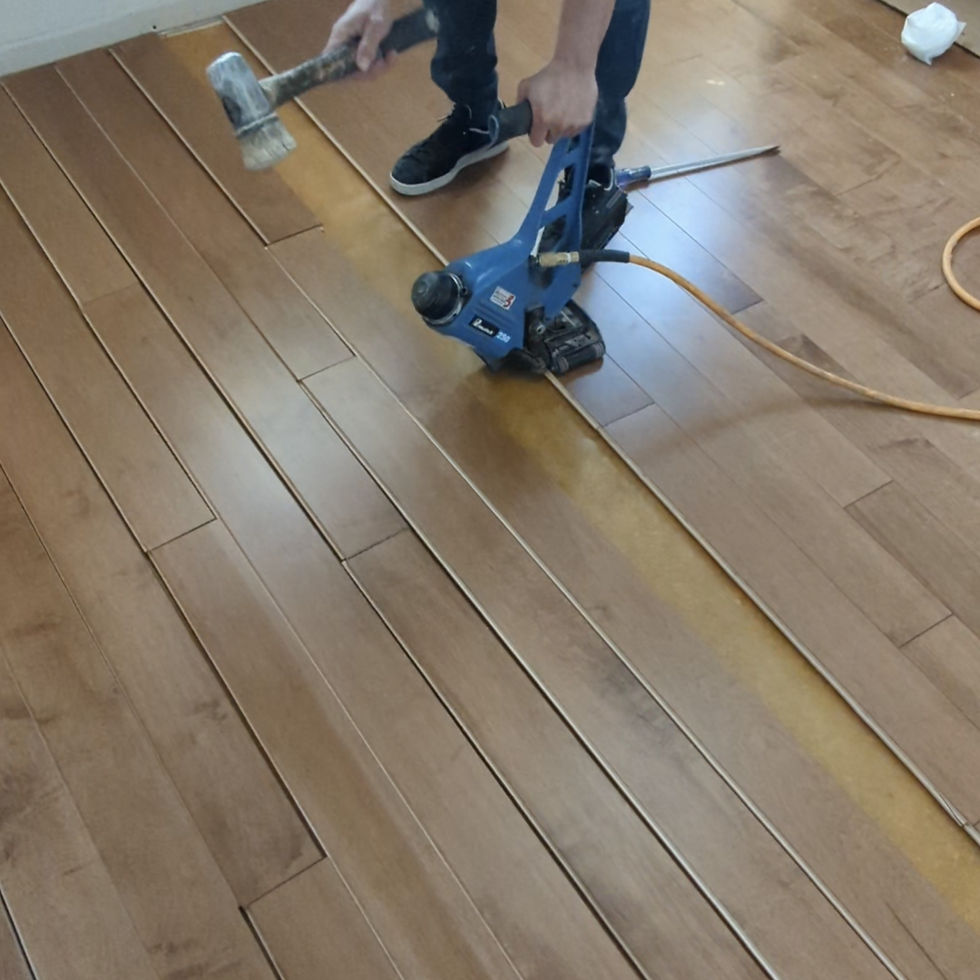
Straight-plank flooring is one of the most common hardwood installation methods in Toronto homes.
The planks are installed in parallel rows, typically following the selected room layout and appropriate installation requirements.
This method is generally more economical than decorative patterns because it involves fewer complicated cuts and less detailed layout work.
Glue-Down Engineered Hardwood Installation
Typical labour cost: $3.00–$4.50 per square foot
Glue-down flooring installation involves bonding engineered hardwood flooring to an approved substrate using compatible flooring adhesive.
This method is particularly relevant for some Toronto condos with concrete subfloors.
However, the concrete must meet the manufacturer's moisture and flatness requirements.
Adhesive is an additional material expense.
As a general reference, some professional hardwood flooring adhesives cost approximately $170 per pail. The quantity required depends on the adhesive system, specified trowel, and coverage.
Double glue-down installations involving approved acoustic underlayment may require additional adhesives and materials.
Floating Click-Lock Engineered Hardwood Installation
Typical labour cost: $1.50–$2.50 per square foot
Some engineered hardwood flooring products are designed for floating installation.
Instead of fastening the planks directly to the subfloor, the flooring system connects together above a compatible underlayment.
Floating installation can be more economical when the product and site conditions are suitable.
However, it is important to follow the manufacturer's rules concerning maximum installation dimensions, expansion spaces, underlayment, and fixed cabinetry.
Herringbone Hardwood Flooring Installation
Typical labour cost: $5.50–$7.50 per square foot
Herringbone hardwood flooring involves arranging planks in a repeating geometric pattern.
It requires precise measurements, careful layout planning, additional cuts, and experienced installation.
Because of this, herringbone flooring generally costs significantly more to install than conventional straight-plank hardwood.
Custom borders and complicated room layouts may increase the final cost.
3. How Much Does Hardwood Flooring Cost for 300, 500, or 1,000 Square Feet?
To help Toronto homeowners estimate their renovation budget, let's calculate a few common project sizes.
The following examples use Parqueteam's engineered hardwood material price range of $4.99–$11.99 per square foot and standard straight-plank installation labour of $2.50–$3.50 per square foot.
Flooring Area | Basic Materials + Installation Labour |
300 sq. ft. | $2,247–$4,647 |
500 sq. ft. | $3,745–$7,745 |
800 sq. ft. | $5,992–$12,392 |
1,000 sq. ft. | $7,490–$15,490 |
Important: These examples calculate flooring materials at the measured floor area, without additional material for cutting waste. They also exclude removal, subfloor preparation, adhesives, trim, delivery, taxes, and project minimum charges.
Your actual material order may need to be larger than the measured area.
Example: 500-Square-Foot Toronto Living Room
Imagine replacing the flooring throughout a 500-square-foot living and dining area.
If you select engineered hardwood priced at $6.99 per square foot, your flooring materials for the measured area would cost approximately $3,495.
At an installation rate of $3.00 per square foot, labour would cost approximately $1,500.
Your initial subtotal would be:
Engineered hardwood flooring: $3,495.
Installation labour: $1,500.
Basic subtotal: $4,995.
Assuming a 10% material allowance for waste, the hardwood material cost would increase by approximately $349.50.
That brings the estimated materials and labour subtotal to $5,344.50, before other project expenses and applicable taxes.
This is an illustrative budget rather than a formal quotation.
4. What Additional Costs Should Toronto Homeowners Expect?
One of the most common budgeting mistakes is calculating hardwood flooring costs using only the material price and installation labour.
Several additional expenses can affect the final project total.
Removal of Existing Flooring
Before installing new hardwood flooring, the existing flooring may need to be removed.
Removal costs depend on the material and installation method.
For example, removing an old floating laminate floor may be relatively straightforward, while removing glue-down hardwood or multiple layers of flooring can require considerably more work.
Disposal and transportation may also be charged separately.
Subfloor Preparation and Levelling
A properly prepared subfloor is essential for hardwood flooring performance.
Older Toronto houses may have plank subfloors, damaged plywood, uneven sections, or areas that move and squeak.
Condo units often have concrete slabs that require moisture testing and flatness corrections.
Depending on the project, preparation may involve:
Securing loose subfloor boards.
Replacing damaged plywood.
Adding an approved plywood underlayment.
Grinding concrete high spots.
Filling low areas.
Addressing excessive moisture.
Removing old adhesive residue.
Subfloor preparation can significantly affect the final price and should never be overlooked simply to reduce the initial quote.
Flooring Adhesives and Underlayment
Some engineered hardwood flooring installations require full-spread adhesives, acoustic membranes, or approved floating-floor underlayment.
The materials must be compatible with the selected flooring and installation method.
In Toronto condos, the building's acoustic requirements can also influence which flooring system is permitted.
Baseboards, Shoe Moulding, and Transitions
A completed hardwood flooring installation often requires additional finishing details.
These may include new baseboards, shoe moulding, reducers, transition strips, and stair nosings.
Even when the hardwood itself is affordable, finishing materials and labour can increase the total cost.
Furniture Moving and Site Access
Moving heavy furniture may require additional labour.
Condo projects can also involve elevator reservations, loading restrictions, parking arrangements, and designated working hours.
These considerations should be discussed before the installation begins.
5. Hardwood Flooring Installation Costs in Toronto Houses vs. Condos
The type of property can affect the installation method, preparation requirements, and final budget.
Installing Hardwood Flooring in Toronto Houses
Many houses have plywood or existing wood-based subfloors suitable for certain nail-down or nail-and-glue-assist systems.
Depending on the condition of the property, installation may be relatively straightforward.
However, older Toronto houses sometimes have uneven subfloors, structural movement, or previous flooring layers that need attention.
Renovations involving several rooms may also require careful planning around doorways, staircases, and floor-height transitions.
Installing Hardwood Flooring in Toronto Condos
Many condominium units have concrete subfloors.
Depending on the engineered hardwood product and building requirements, installation may involve glue-down, double glue-down, or a compatible floating system.
Condominium corporations may require:
Flooring renovation approval.
Acoustic underlayment specifications.
Minimum sound-control performance.
Contractor insurance documentation.
Elevator and delivery reservations.
A lower installation labour rate does not necessarily mean a lower overall condo renovation cost.
For example, a floating installation may have lower labour costs but still require additional materials to meet acoustic requirements.
Before purchasing hardwood flooring for a condo, confirm the building's approved flooring systems.
6. Is Engineered Hardwood Flooring Cheaper Than Solid Hardwood?
Not necessarily.
Some engineered hardwood products cost less than solid hardwood, while premium engineered hardwood flooring can cost more than certain solid hardwood products.
The final installed price depends on both the flooring material and the installation method.
Engineered hardwood may be more suitable for concrete subfloors because many products are approved for glue-down installation.
Solid hardwood may provide greater refinishing potential, depending on its thickness and installation.
For Toronto homeowners, the right choice should be based on the property's conditions, desired appearance, expected lifespan, and overall budget.

7. Is It Cheaper to Install Hardwood Flooring Yourself?
DIY hardwood flooring installation may reduce labour expenses, but it introduces several risks.
Homeowners must consider the cost of specialized tools, subfloor preparation, material waste, and the possibility of installation mistakes.
Incorrect installation may cause:
Uneven or poorly aligned planks.
Squeaking or movement.
Inadequate expansion gaps.
Adhesive bonding problems.
Damage caused by improper moisture control.
Flooring warranty concerns.
Some click-lock flooring systems are more accessible to experienced DIY homeowners than glue-down or custom-pattern installations.
However, professional installation is often worth considering for large spaces, expensive hardwood products, condos, and complicated layouts.
8. How Can You Reduce Hardwood Flooring Installation Costs?
Choosing the least expensive hardwood product is not always the best way to control your renovation budget.
There are several practical ways to manage costs while maintaining installation quality.
Choose a Straight-Plank Layout
Straight-plank flooring generally costs less to install than herringbone or custom patterns.
It also works with a wide range of interior styles.
Select Flooring That Matches Your Subfloor
Choosing a product compatible with your existing subfloor can help avoid unnecessary construction work.
For example, a properly selected engineered hardwood system may be more practical than modifying a concrete subfloor to accommodate an unsuitable product.
Compare Flooring Products Carefully
Evaluate hardwood construction, finish quality, wear-layer thickness, warranty, and manufacturer reputation rather than focusing exclusively on the price per box.
Plan Multiple Rooms Together
Combining adjacent flooring areas into one project may reduce repeated setup, deliveries, and mobilization costs.
This depends on the property layout and contractor's pricing structure.
Obtain a Detailed Written Estimate
A comprehensive quotation should explain which services and materials are included.
This helps homeowners compare estimates accurately instead of selecting a low initial price that excludes essential work.
9. Hardwood Installation vs. Refinishing: Which Costs Less?
If your property already has hardwood flooring in reasonably good condition, refinishing may be more economical than replacing it.
Professional hardwood floor refinishing involves sanding the existing hardwood surface and applying an appropriate protective finish.
Depending on the floor's condition, homeowners may also be able to change the stain colour.
However, refinishing is not suitable for every floor.
Severely damaged boards, structural problems, extensive water damage, or thin engineered hardwood wear layers can limit restoration options.
At Parqueteam Hardwood Flooring, we offer dustless hardwood floor refinishing throughout Toronto and the Greater Toronto Area.
Before committing to new hardwood installation, it may be worthwhile to evaluate whether the existing floor can be restored.
10. What Should Be Included in a Hardwood Flooring Installation Quote?
A written hardwood flooring estimate should clearly identify the scope of work.
Before hiring a contractor, review the following:
Hardwood flooring product and specifications.
Installation method.
Flooring area and estimated material quantities.
Installation labour charges.
Old flooring removal and disposal, if required.
Subfloor preparation allowances.
Adhesives and underlayment.
Baseboards, mouldings, and transitions.
Project minimum charges and additional work conditions.
Applicable taxes.
Estimated project schedule.
Contractor insurance and WSIB coverage are also important considerations when choosing a flooring company.
The least expensive quotation is not always the best value if essential installation requirements are excluded.

Frequently Asked Questions About Hardwood Flooring Installation Costs in Toronto
How much does it cost to install hardwood flooring in Toronto in 2026?
For standard engineered hardwood flooring, Parqueteam's general material and straight-plank installation labour ranges combine to approximately $7.49–$15.49 per square foot, before waste, subfloor preparation, removal, adhesives, trim, and taxes. Solid hardwood and specialty installations require product-specific estimates.
How much does it cost to install 1,000 square feet of hardwood flooring?
Using the engineered hardwood price ranges in this guide, a 1,000-square-foot installation may cost approximately $7,490–$15,490 for basic materials and straight-plank installation labour. Additional material quantities, preparation, and finishing expenses can increase the final total.
How much does hardwood flooring installation labour cost in Toronto?
At Parqueteam, straight-plank hardwood installation labour generally ranges from $2.50–$3.50 per square foot. Glue-down engineered hardwood labour ranges from $3.00–$4.50, while herringbone and custom-pattern installation typically ranges from $5.50–$7.50 per square foot.
Is engineered hardwood flooring cheaper to install than solid hardwood?
It depends on the product and installation method. Engineered hardwood can be installed using several approved methods, some of which may offer lower labour costs. Premium engineered products can also cost more than some solid hardwood materials.
Does installing hardwood flooring increase home value?
Well-maintained hardwood flooring can improve the presentation and appeal of a home. However, the return on investment varies depending on the property, local market conditions, flooring quality, and installation cost. A financial return is not guaranteed.
How much extra hardwood flooring should I order?
Many standard installations require additional material for cuts and waste. An allowance of approximately 5–10% may be a useful starting point for straightforward layouts, while irregular rooms or herringbone patterns may require more. The installer should determine the quantity for the actual project.
Is hardwood flooring installation more expensive in a condo?
It can be. Condo flooring projects may require acoustic underlayment, approved installation systems, additional delivery arrangements, and building approvals. The final cost depends on the property and condominium requirements.
Are flooring removal and subfloor preparation included in installation prices?
Not necessarily. Some contractors quote these services separately. Always confirm whether the estimate includes removal, disposal, levelling, moisture-related preparation, and trim work.
Is it cheaper to refinish existing hardwood than replace it?
Refinishing is often more economical when the existing hardwood flooring is structurally sound and has sufficient material remaining for sanding. Floors with extensive damage may require partial or complete replacement.
Does herringbone hardwood flooring cost more to install?
Yes. Herringbone generally involves more detailed layout work, precision cutting, and installation time. At Parqueteam, typical herringbone installation labour ranges from $5.50–$7.50 per square foot.
Final Thoughts: Budgeting for Hardwood Flooring Installation in Toronto
Hardwood flooring installation is a long-term investment that should be planned around the property, flooring product, and intended installation method.
While material and labour prices provide a useful starting point, the total project cost also depends on subfloor preparation, flooring removal, adhesives, transitions, and other finishing work.
For Toronto homeowners, choosing a quality hardwood product and an appropriate installation system is more important than simply selecting the lowest advertised price.
Get a Hardwood Flooring Installation Estimate in Toronto
At Parqueteam Hardwood Flooring, we specialize in solid and engineered hardwood flooring installation throughout Toronto and the Greater Toronto Area.
Our services include standard straight-plank installation, glue-down engineered hardwood, nail-and-glue-assist systems, and custom herringbone flooring.
We also provide dustless hardwood floor refinishing for homeowners considering restoration instead of complete replacement.
Our team can assess your existing flooring and subfloor, review the selected hardwood product, and provide an estimate based on your project requirements.


Comments