
Pros and Cons of Engineered Hardwood Flooring: Is It Worth It?
Engineered hardwood flooring has become a popular choice for Toronto houses and condos, offering the appearance of genuine hardwood flooring with a construction designed to provide greater dimensional stability.
But is engineered hardwood flooring worth it?
For homeowners who want genuine wood flooring, wider planks and flexible installation options, engineered hardwood flooring can be an excellent investment. However, it isn't waterproof, some products have limited refinishing potential, and premium options can be expensive.
The right choice depends on your property, lifestyle, budget and long-term expectations.
In this guide, we'll examine the advantages and disadvantages of engineered hardwood flooring, explain how it compares with solid hardwood flooring, and help determine whether it suits your Toronto home.

Engineered Hardwood Flooring Pros and Cons at a Glance
Advantages | Disadvantages |
Genuine hardwood surface | Not waterproof |
Greater dimensional stability than many solid hardwood flooring products | Limited refinishing potential on some products |
Suitable installation options for concrete and plywood subfloors | Quality varies between manufacturers |
Available in wide and long planks | Can scratch or dent |
Wide range of colours and wood species | Premium products can be expensive |
Potential compatibility with radiant heating | Requires appropriate humidity and temperature control |
Certain products can be refinished | Subfloor preparation and installation requirements can add costs |
What Is Engineered Hardwood Flooring?
Engineered hardwood flooring is manufactured using a genuine hardwood surface bonded to a layered supporting structure.
Depending on the product, the core may be constructed from plywood, multiple wood veneers or other engineered materials.
The top surface is real hardwood flooring, not a printed photograph of wood.
This distinguishes engineered hardwood flooring from laminate flooring and vinyl plank flooring.
Engineered hardwood flooring is available in numerous species and finishes, including white oak, European oak, maple, walnut and other popular wood varieties.
Common overall thicknesses range from approximately 3/8 inch to 3/4 inch, although specifications vary by manufacturer.
The layered construction is one of its most important advantages.
1. Advantage: Greater Dimensional Stability
One of the biggest benefits of engineered hardwood flooring is its dimensional stability.
Wood naturally reacts to changes in temperature and relative humidity.
In Toronto, indoor conditions can vary considerably between the heating season and humid summer months.
Solid hardwood flooring expands and contracts as moisture conditions change.
Engineered hardwood flooring is designed with layered construction that generally reduces dimensional movement compared with equivalent solid hardwood flooring.
Why This Matters for Toronto Homes
Greater dimensional stability can be particularly beneficial in:
Homes with seasonal humidity changes.
Properties with wider hardwood flooring planks.
Condominiums with concrete subfloors.
Suitable finished basements.
Renovations requiring specialized installation systems.
However, greater dimensional stability does not mean engineered hardwood flooring is immune to moisture damage.
Maintaining appropriate indoor conditions and following the manufacturer's requirements remain essential.
2. Advantage: Genuine Hardwood Appearance
Engineered hardwood flooring has a real hardwood surface.
For homeowners who prefer natural wood, this is a major advantage over laminate flooring and vinyl plank flooring.
Every hardwood plank has natural grain, colour variation and unique characteristics.
Depending on the selected species and finish, engineered hardwood flooring can create a traditional, contemporary or luxury interior.
Popular Engineered Hardwood Flooring Styles in Toronto
Natural white oak: Light, neutral colouring that works well in modern interiors.
European oak: Available in refined natural tones, textured finishes and wide-plank formats.
Warm brown hardwood flooring: A classic choice for traditional and transitional homes.
Wire-brushed hardwood flooring: Emphasizes natural wood texture and can make certain minor surface marks less noticeable.
Matte hardwood flooring: Offers a relatively understated appearance compared with high-gloss finishes.
For homeowners who value authentic wood grain, engineered hardwood flooring is often worth the additional cost over synthetic wood-look alternatives.
3. Advantage: More Installation Options
These can include floating, glue-down and nail-and-glue-assisted installations.
Floating Engineered Hardwood Flooring
Certain click-lock engineered hardwood flooring products are suitable for floating installation over approved underlayment.
This approach can be useful in selected residential renovations when the subfloor and flooring specifications allow it.
However, not all engineered hardwood flooring products can be floated.
Glue-Down Engineered Hardwood Flooring
Glue-down engineered hardwood flooring is bonded to a suitable substrate with approved flooring adhesive.
This is often considered for concrete subfloors in Toronto condos and other appropriate properties.
Concrete moisture conditions, flatness and adhesive compatibility must be evaluated.
Nail-and-Glue-Assisted Installation
For suitable plywood subfloors, nail-and-glue-assisted installation can be appropriate for certain engineered hardwood flooring products, including wider planks.
The installation method should follow the manufacturer's specifications.
The main benefit is flexibility: engineered hardwood flooring offers options for different property conditions that may be less practical with conventional solid hardwood flooring.
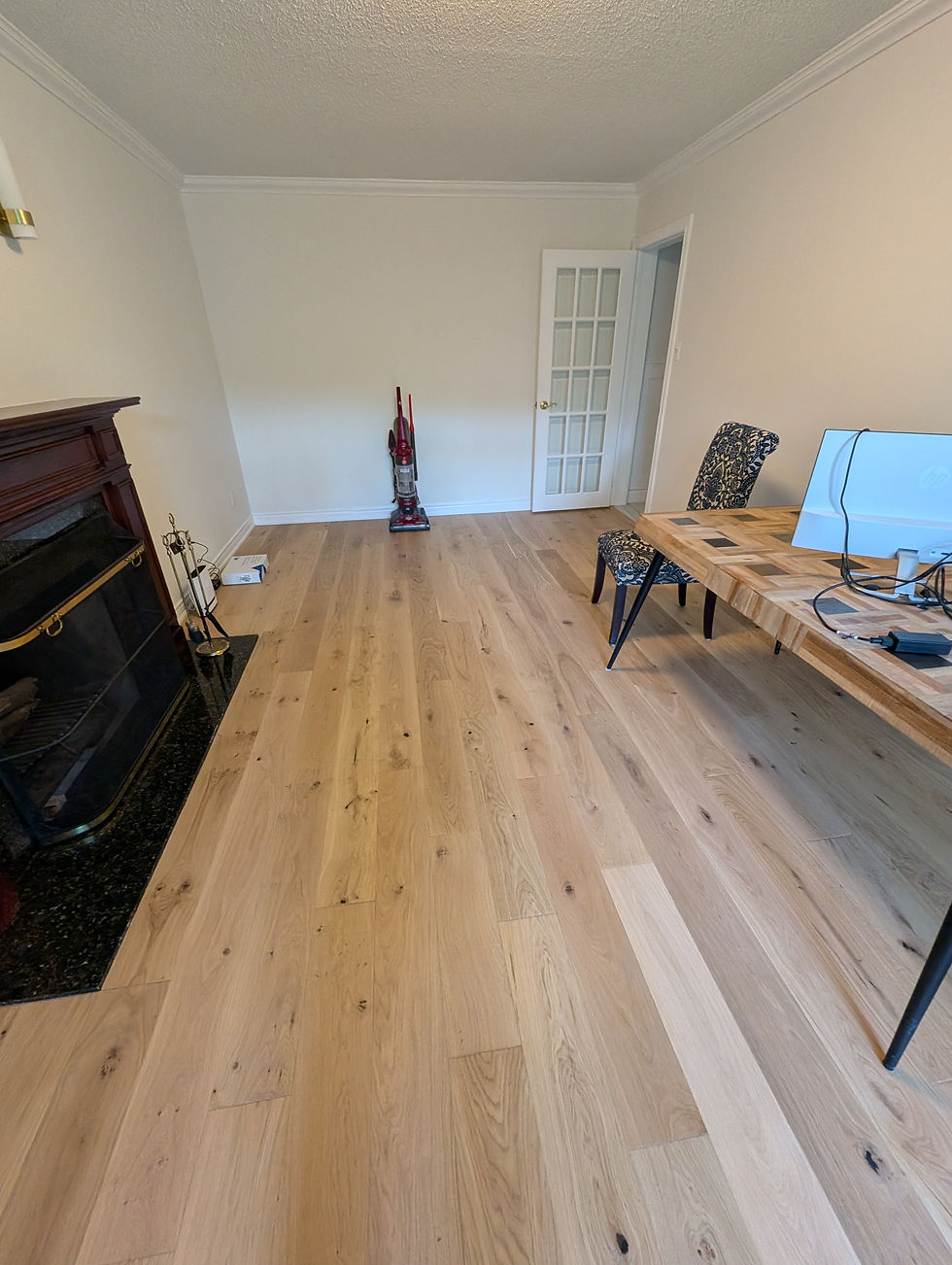
4. Advantage: Available in Wider Hardwood Flooring Planks
Wide-plank hardwood flooring is a popular design choice in Toronto homes.
Longer and wider boards can create a spacious, contemporary appearance with fewer visible seams.
Engineered hardwood flooring's layered construction can provide additional dimensional stability for wider plank formats.
However, wide engineered hardwood flooring still requires appropriate installation methods, expansion allowances and indoor humidity control.
Plank width alone shouldn't determine product selection.
A high-quality wide-plank engineered hardwood flooring product is particularly attractive for open-concept living rooms, dining rooms and renovated main floors.
5. Advantage: Suitable for Many Toronto Condo Renovations
Engineered hardwood flooring is a strong option for condominiums where a genuine hardwood surface is desired.
Many Toronto condos have concrete subfloors, making conventional mechanically fastened solid hardwood flooring installations more complicated.
Engineered hardwood flooring offers additional options, including certain floating and glue-down systems.
What About Condo Soundproofing?
An engineered hardwood flooring product does not automatically satisfy a condominium's acoustic requirements.
The approved flooring assembly may need an acoustic membrane or other specified materials.
Building management may require documentation for IIC or STC performance.
The relevant performance depends on the tested flooring assembly, not simply the hardwood flooring plank.
Before purchasing materials, confirm the condominium corporation's renovation and flooring requirements.
6. Advantage: Some Engineered Hardwood Flooring Can Be Refinished
Unlike laminate flooring and vinyl plank flooring, engineered hardwood flooring has a genuine hardwood surface.
Certain products can therefore be sanded and refinished.
However, refinishing hardwood flooring potential depends on the thickness of the usable hardwood layer, surface construction and condition.
A product with a thin hardwood veneer may not be suitable for conventional sanding.
A product with a sufficiently substantial wear layer may allow refinishing, but the number of possible refinishes cannot be determined from overall plank thickness alone.
If future refinishing is important to you, confirm the manufacturer's specifications before purchasing.

7. Disadvantage: Engineered Hardwood Flooring Is Not Waterproof
One of the most important limitations is moisture sensitivity.
Although engineered hardwood flooring generally experiences less dimensional movement than solid hardwood flooring, its visible surface is still natural wood.
Prolonged water exposure can cause swelling, cupping, delamination or finish damage.
Is Engineered Hardwood Flooring Suitable for Kitchens?
It can be suitable for residential kitchens when the selected product is approved and homeowners understand the maintenance requirements.
However, spills should be cleaned promptly.
Dishwasher leaks and other plumbing problems can damage engineered hardwood flooring.
For households prioritizing water resistance, vinyl plank flooring may be a more practical alternative.
What About Basements?
Some engineered hardwood flooring products are approved for below-grade basement flooring installations.
However, the basement must meet the product's moisture and environmental requirements.
Engineered hardwood flooring should not be installed over unresolved water infiltration or recurring flooding.
8. Disadvantage: Limited Refinishing Potential
Not every engineered hardwood flooring product can be refinished.
This is one of the most important differences between engineered hardwood flooring and solid hardwood flooring.
Solid hardwood flooring often contains enough usable wood for multiple refinishing cycles.
Engineered hardwood flooring may have a much thinner genuine hardwood surface.
Some products cannot be conventionally refinished at all.
For a homeowner planning to keep the same flooring for several decades, this difference deserves attention.
What to check before buying: Ask for the actual hardwood wear-layer thickness and documented refinishing recommendations, not simply the overall flooring thickness.
9. Disadvantage: Quality Varies Considerably
The term engineered hardwood flooring describes a broad product category.
It does not guarantee that every product is manufactured to the same standard.
Differences may include:
Core construction and stability.
Quality of the bonding process.
Hardwood wear-layer thickness.
Factory finish durability.
Plank dimensions and milling accuracy.
Manufacturer warranty and installation requirements.
A poorly manufactured engineered hardwood flooring product can cause problems even when installed correctly.
For this reason, we recommend evaluating product specifications rather than purchasing solely by price, brand name or board thickness.
10. Disadvantage: Engineered Hardwood Flooring Can Scratch and Dent
Engineered hardwood flooring has a genuine wood surface, so it can develop scratches and dents.
Furniture movement, pets, footwear debris and dropped objects may damage the finish or wood beneath it.
The extent of damage depends on the wood species, finish, product construction and household activities.
How to Reduce Surface Damage
Use suitable furniture pads and protective chair accessories.
Sweep regularly to remove sand and grit.
Avoid dragging furniture across the flooring.
Maintain indoor humidity within the manufacturer's recommended range.
Choose wood species and finishes that suit the household's expected use.
No genuine hardwood flooring surface should be described as completely scratchproof.
11. Disadvantage: Premium Products Can Be Expensive
Engineered hardwood flooring is sometimes marketed as a less expensive alternative to solid hardwood flooring.
However, this isn't always true.
Premium engineered hardwood flooring can cost as much as, or more than, certain solid hardwood flooring products.
At Parqueteam Hardwood Flooring, engineered hardwood flooring material prices generally range from $4.99–$11.99 per square foot.
Installation labour depends on the method:
Installation Method | Labour Cost |
Click-lock floating installation | $1.50–$2.50/sq. ft. |
Nail-and-glue-assisted installation | $2.50–$3.50/sq. ft. |
Full glue-down installation | $3.00–$4.50/sq. ft. |
Herringbone or custom-pattern installation | $5.50–$7.50/sq. ft. |
Adhesives, acoustic underlayment, removal, subfloor preparation, finishing and taxes are additional.
These figures are included for context. The final decision should consider long-term suitability, not simply the lowest installation price.
Engineered Hardwood Flooring vs. Solid Hardwood Flooring
Both are genuine hardwood flooring options, but they have different characteristics.
Feature | Engineered Hardwood Flooring | Solid Hardwood Flooring |
Surface | Genuine hardwood | Genuine hardwood |
Construction | Layered structure | Solid wood throughout |
Dimensional stability | Generally greater | More sensitive to moisture changes |
Concrete installation | Many approved options | More restrictive, system-dependent |
Refinishing | Product-dependent | Often multiple times |
Wide planks | Many stable options | Requires careful installation and moisture control |
Water resistance | Not waterproof | Not waterproof |
Material cost | Broad price range | Broad price range |
When Solid Hardwood Flooring May Be Better
Solid hardwood flooring deserves consideration when the home has a suitable wood subfloor and the homeowner prioritizes future refinishing.
It can be an attractive long-term option for traditional houses.
When Engineered Hardwood Flooring May Be Better
Engineered hardwood flooring is particularly attractive when the property has concrete subfloors, requires a wider plank, or benefits from additional installation flexibility.
Neither is universally better.
Is Engineered Hardwood Flooring Better Than Laminate Flooring or Vinyl Plank Flooring?
The answer depends on your priorities.
Engineered hardwood flooring is usually preferable when genuine wood appearance is the main priority.
Laminate flooring may offer a more economical wood-look solution with suitable abrasion resistance for dry rooms.
Vinyl plank flooring may be preferable where everyday spills, practical maintenance or rental-property use are important considerations.
All three can be suitable in Toronto homes and condos when correctly specified and installed.
However, only engineered hardwood flooring among these options provides a genuine hardwood surface.
Who Should Choose Engineered Hardwood Flooring?
Engineered hardwood flooring is particularly worth considering for homeowners who:
Prefer genuine natural wood rather than printed wood-look flooring.
Want wide planks or premium hardwood flooring finishes.
Have a condo or property with a concrete subfloor.
Are planning a long-term renovation.
Can maintain appropriate indoor humidity conditions.
Understand that hardwood flooring requires ongoing care.
When Might Another Flooring Be Better?
Vinyl plank flooring may make more sense for rental properties, areas with frequent spills or homeowners prioritizing water resistance.
Laminate flooring may provide better value for certain budget-conscious renovations in dry rooms.
Solid hardwood flooring may be more attractive to homeowners who place a high priority on multiple future refinishing cycles.

Frequently Asked Questions About Engineered Hardwood Flooring
What are the main advantages of engineered hardwood flooring?
The main advantages include genuine hardwood appearance, greater dimensional stability than many solid hardwood flooring products, installation flexibility and a wide range of plank sizes and finishes.
What are the biggest disadvantages of engineered hardwood flooring?
Its main disadvantages include moisture sensitivity, potential scratching, variable product quality, premium pricing and limited refinishing potential on certain products.
Is engineered hardwood flooring worth the money?
It can be an excellent investment for homeowners who want genuine hardwood flooring and an installation system suitable for their property. Whether the additional cost is worthwhile depends on budget, product quality and long-term expectations.
Can engineered hardwood flooring be installed in a Toronto condo?
Yes. Many engineered hardwood flooring products are suitable for condo installations when the selected system meets concrete subfloor, acoustic and building approval requirements.
Is engineered hardwood flooring waterproof?
No. Its layered construction generally provides additional dimensional stability, but the genuine hardwood surface and underlying components can still be damaged by prolonged moisture exposure.
How long does engineered hardwood flooring last?
Its useful lifespan varies considerably with product quality, wear-layer construction, installation, traffic and maintenance. A fixed lifespan cannot be guaranteed for the entire category.
Can engineered hardwood flooring be sanded and refinished?
Some products can, while others cannot. Refinishing depends on the usable hardwood wear-layer thickness, construction and condition.
Is engineered hardwood flooring cheaper than solid hardwood flooring?
Not always. Entry-level engineered hardwood flooring may cost less than certain solid hardwood flooring products, while premium engineered products can be more expensive.
Final Verdict: Is Engineered Hardwood Flooring Right for Your Toronto Home?
Engineered hardwood flooring offers a compelling combination of genuine wood appearance, dimensional stability and installation flexibility.
For many Toronto homeowners, especially those renovating condos, open-concept spaces or properties with concrete subfloors, it is an excellent flooring option.
However, engineered hardwood flooring is not waterproof, and its long-term refinishing potential varies considerably by product.
The best choice is a quality product with an appropriate wear layer, suitable installation system and specifications that match the property.
Rather than asking whether engineered hardwood flooring is always better than solid hardwood flooring, laminate flooring or vinyl plank flooring, consider which material best meets your home's requirements.
Professional Engineered Hardwood Flooring Installation in Toronto
At Parqueteam Hardwood Flooring, we provide professional engineered hardwood flooring installation throughout Toronto and the Greater Toronto Area.
Our services include floating, glue-down, double glue-down and nail-and-glue-assisted installations, along with herringbone engineered hardwood flooring for suitable properties.
We can evaluate existing subfloors, installation requirements and product specifications to help homeowners select an appropriate flooring system.
Parqueteam maintains WSIB coverage and liability insurance.


Comments