
Best Hardwood Flooring for Toronto Homes: Species, Durability & Buying Guide
What is the best hardwood flooring for Toronto homes?
For many homeowners, white oak hardwood flooring is one of the best overall choices, offering a desirable combination of durability, attractive grain, versatile colours and suitability for both traditional and contemporary interiors.
However, white oak hardwood flooring isn't necessarily the best option for every house.
Red oak hardwood flooring is excellent for traditional properties and matching existing floors. Maple hardwood flooring provides a cleaner, more uniform appearance. Hickory hardwood flooring offers excellent resistance to indentation, while walnut hardwood flooring appeals to homeowners seeking a distinctive, premium finish.
Beyond wood species, Toronto homeowners must also decide between solid hardwood flooring and engineered hardwood flooring, consider the existing subfloor and account for seasonal humidity changes.
This guide explains how to choose the best hardwood flooring for your Toronto home based on durability, appearance, maintenance, installation conditions and long-term value.

Best Hardwood Flooring for Toronto Homes: Quick Comparison
Hardwood Flooring Species | Main Advantage | Best Suited For |
White oak hardwood flooring | Balanced durability and versatile appearance | Most modern and transitional homes |
Red oak hardwood flooring | Traditional appearance and renovation compatibility | Older Toronto houses |
Maple hardwood flooring | Light colour and fine grain | Contemporary interiors |
Hickory hardwood flooring | High resistance to indentation | Busy family homes |
Walnut hardwood flooring | Rich natural colour and distinctive character | Premium, lower-traffic interiors |
Brazilian cherry hardwood flooring | Dense wood and dramatic colour | Distinctive design projects |
All these species are available in different products and finishes. Actual suitability depends on the flooring construction, grade, manufacturer and installation conditions.
1. White Oak Hardwood Flooring: Best Overall Choice
White oak hardwood flooring is one of our preferred recommendations for Toronto homeowners looking for an attractive, versatile wood floor.
Its natural grain complements contemporary, transitional and traditional interiors.
White oak hardwood flooring is available in numerous finishes, from light natural tones to warm brown and darker stained colours.
Why Choose White Oak Hardwood Flooring?
Durability: White oak has good resistance to indentation for ordinary residential use.
Versatile appearance: Its grain works well with many interior styles.
Finish selection: White oak hardwood flooring is available in natural, matte, wire-brushed and stained finishes.
Product variety: Homeowners can choose between solid hardwood flooring and engineered hardwood flooring constructions.
Wide-plank availability: White oak is a popular choice for modern wide-plank engineered hardwood flooring.
Are There Any Disadvantages?
White oak hardwood flooring is not waterproof or scratchproof.
Premium wide-plank and European white oak flooring products can also be relatively expensive.
Some white oak products have substantial colour and grain variation, so homeowners should examine full-size samples before ordering.
Our Recommendation
For homeowners replacing flooring throughout a Toronto main floor or planning a contemporary renovation, quality white oak engineered hardwood flooring is an excellent starting point.
For traditional houses with suitable plywood subfloors, solid white oak hardwood flooring is also worth considering.
2. Red Oak Hardwood Flooring: Best for Traditional Toronto Houses
Red oak hardwood flooring is a classic choice found in many older Toronto homes.
It has a noticeable grain pattern and naturally warm undertones.
In established neighbourhoods with traditional houses, existing red oak hardwood flooring is common enough that matching or refinishing it can sometimes be preferable to replacing it.
Advantages of Red Oak Hardwood Flooring
Warm, familiar hardwood appearance.
Distinctive grain that can make certain minor marks less noticeable.
Wide availability of traditional solid hardwood flooring products.
Can be sanded and refinished when sufficient usable wood remains.
Suitable for many residential living spaces.
When Is Red Oak Hardwood Flooring the Better Choice?
Red oak hardwood flooring is particularly appropriate when extending existing hardwood flooring into another room.
It can also be an excellent choice for homeowners who prefer classic interior finishes rather than the cooler or more neutral appearance of certain white oak products.
What Should Homeowners Consider?
Red oak has more pronounced pink and warm undertones than white oak.
Achieving certain pale or neutral stain colours can be more challenging, particularly when trying to eliminate its natural reddish appearance.
If your existing red oak hardwood flooring is still in good condition, professional hardwood floor refinishing may be more economical than full replacement.
3. Maple Hardwood Flooring: Best for Clean, Contemporary Interiors
Maple hardwood flooring has a finer, more subtle grain pattern than oak.
Its natural appearance is often light and relatively uniform, making it attractive for modern and minimalist interiors.
Hard maple also has excellent resistance to indentation.
Advantages of Maple Hardwood Flooring
Light appearance: Natural maple hardwood flooring can help create a bright interior.
Subtle grain: Homeowners who dislike pronounced oak grain may prefer maple.
Indentation resistance: Hard maple is well suited to ordinary residential foot traffic.
Natural finishing: Maple can look particularly attractive with a clear or lightly tinted finish.
Disadvantages of Maple Hardwood Flooring
Because maple has a relatively subtle grain, certain scratches and surface marks may be more noticeable.
Maple can also be challenging to stain evenly, particularly when dark colours are desired.
Our Recommendation
Choose maple hardwood flooring when you want a natural, clean appearance and intend to preserve the wood's relatively light colour.
For darker stained floors, oak hardwood flooring may provide greater flexibility.

4. Hickory Hardwood Flooring: Best for High-Traffic Family Homes
Hickory hardwood flooring is one of the harder commonly used domestic hardwood flooring species.
Its distinctive appearance includes noticeable grain and colour variation.
This can make hickory hardwood flooring particularly attractive for rustic, farmhouse and character-focused interiors.
Advantages of Hickory Hardwood Flooring
Excellent resistance to indentation.
Distinctive natural character.
Strong visual variation between boards.
Suitable for active households when properly installed.
Available in certain engineered hardwood flooring products.
Is Hickory Hardwood Flooring Scratchproof?
No.
Hardness primarily describes resistance to indentation under a standardized test.
It does not guarantee resistance to scratches from sand, furniture or pet claws.
Hickory hardwood flooring can still experience finish wear and surface damage.
Our Recommendation
Hickory hardwood flooring is worth considering for homeowners who want strong indentation resistance and appreciate natural colour variation.
For homeowners seeking a subtle, uniform appearance, white oak or maple hardwood flooring may be preferable.
5. Walnut Hardwood Flooring: Best for Luxury Interiors
Walnut hardwood flooring has a distinctive, naturally rich appearance.
Its deep brown tones and flowing grain patterns can create a refined, premium look.
Walnut is particularly attractive for home offices, bedrooms and formal living spaces.
Advantages of Walnut Hardwood Flooring
Rich natural colour.
Distinctive grain and character.
Premium appearance.
Attractive in both traditional and contemporary interiors.
Often looks beautiful with relatively natural finishes.
Disadvantages of Walnut Hardwood Flooring
Walnut is softer than white oak, red oak, hard maple and hickory.
As a result, it may be more susceptible to dents from concentrated furniture loads or dropped objects.
It can also be expensive.
Our Recommendation
Choose walnut hardwood flooring when natural appearance is your priority and you are comfortable with its maintenance characteristics.
For a particularly busy household, white oak or hickory hardwood flooring may be more practical.
6. Hardwood Flooring Hardness: Does the Janka Rating Matter?
The Janka hardness test measures the force required to embed a steel ball into a wood sample under standardized conditions.
It provides a useful comparison of resistance to indentation.
Here are approximate published Janka hardness values for common hardwood flooring species.
Hardwood Species | Janka Hardness |
American black walnut | 1,010 lbf |
Red oak | 1,290 lbf |
White oak | 1,360 lbf |
Hard maple | 1,450 lbf |
Hickory | 1,820 lbf |
Brazilian cherry (Jatoba) | 2,350 lbf |
These are representative species values. Wood characteristics can vary, and commercial product performance depends on more than species hardness.
Does Harder Hardwood Flooring Mean Better Flooring?
Not necessarily.
A higher Janka rating generally indicates greater resistance to indentation.
However, it does not directly measure:
Scratch resistance of the floor finish.
Resistance to water damage.
Dimensional stability.
Ease of refinishing.
Product manufacturing quality.
Installation performance.
For most Toronto homes, white oak and red oak offer very practical durability without requiring the hardest available wood species.
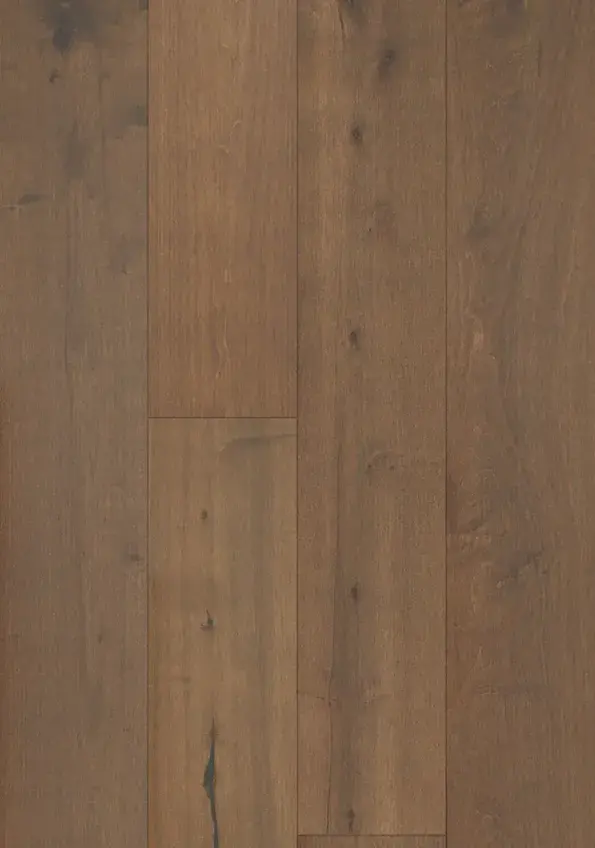
7. Engineered or Solid Hardwood Flooring: Which Should You Choose?
After selecting a wood species, homeowners must decide on the flooring construction.
Both engineered hardwood flooring and solid hardwood flooring use genuine wood surfaces.
Solid Hardwood Flooring
Solid hardwood flooring is manufactured from one piece of wood.
It is especially well suited to traditional houses with appropriate wood subfloors.
One of its biggest advantages is the potential for multiple future sanding and refinishing cycles.
However, solid hardwood flooring is generally more sensitive to dimensional changes associated with humidity.
Engineered Hardwood Flooring
Engineered hardwood flooring uses a genuine hardwood surface bonded to a layered supporting core.
Its construction generally provides greater dimensional stability and additional installation options.
Depending on the product, engineered hardwood flooring may be approved for floating, glue-down or nail-and-glue-assisted installation.
Our Recommendation for Toronto Homes
For traditional houses with suitable plywood subfloors, both constructions are excellent options.
For condo floors with concrete subfloors, engineered hardwood flooring is generally the more practical starting point.
The choice should be based on subfloor conditions, installation requirements and future refinishing expectations.
8. What Hardwood Flooring Is Best for Different Toronto Properties?
The right flooring depends on the property as much as the wood species.
Property Type | Flooring Worth Considering |
Traditional Toronto house | Solid red oak or white oak hardwood flooring |
Modern renovated house | Wide-plank white oak engineered hardwood flooring |
Toronto condo | Approved engineered hardwood flooring system |
Busy family home | White oak, maple or hickory hardwood flooring |
Luxury living room | White oak or walnut hardwood flooring |
Basement with suitable conditions | Manufacturer-approved engineered hardwood flooring |
Home with existing hardwood flooring | Matching and refinishing existing hardwood flooring |
Toronto Condos
Engineered hardwood flooring is often the preferred starting point because many products offer installation systems compatible with properly prepared concrete.
However, condo owners must confirm acoustic underlayment requirements and renovation approvals before purchasing.
Older Toronto Houses
Older houses may have existing red oak, maple or other solid hardwood flooring beneath the current floor covering.
Before replacing the flooring, consider whether the existing hardwood flooring can be repaired and refinished.
Newer Houses and Open-Concept Renovations
Wide-plank white oak engineered hardwood flooring can be an excellent option.
However, long and wide planks require appropriate subfloor flatness, installation methods and indoor environmental conditions.
Basements
Some engineered hardwood flooring products are approved for below-grade use, but only when substrate and moisture conditions meet the manufacturer's requirements.
Engineered hardwood flooring is not waterproof.
For basement floors with recurring moisture problems, hardwood flooring may not be the right choice until the underlying issue is corrected.
9. Which Hardwood Flooring Finish Is Best?
The finish influences both appearance and how noticeable everyday wear may become.
Matte Hardwood Flooring
Matte finishes offer a relatively natural, understated appearance.
They are an attractive option for contemporary interiors.
Satin Hardwood Flooring
Satin finishes provide a moderate sheen and work well in traditional and transitional homes.
Wire-Brushed Hardwood Flooring
Wire-brushed hardwood flooring emphasizes natural wood texture.
Its textured appearance may help make some small surface marks less noticeable.
High-Gloss Hardwood Flooring
High-gloss hardwood flooring creates a reflective appearance but can make scratches, dust and imperfections more visible.
Our Recommendation
For many Toronto family homes, we recommend considering natural or warm white oak hardwood flooring with a quality matte or satin finish.
The selected factory finish should be suitable for the expected traffic and maintenance requirements.
10. How Much Does Quality Hardwood Flooring Cost in Toronto?
Material prices depend on the wood species, flooring construction, grade, finish and manufacturer.
At Parqueteam Hardwood Flooring, engineered hardwood flooring materials generally range from $4.99–$11.99 per square foot.
Our reference engineered hardwood flooring installation labour rates include:
Installation Method | Labour Rate |
Click-lock floating | $1.50–$2.50/sq. ft. |
Nail-and-glue-assisted | $2.50–$3.50/sq. ft. |
Full glue-down | $3.00–$4.50/sq. ft. |
Herringbone/custom patterns | $5.50–$7.50/sq. ft. |
These figures exclude adhesives, underlayment, flooring waste, subfloor preparation, removal, finishing details and HST.
Solid hardwood flooring requires a project-specific estimate.
For homeowners comparing several species, it is important to evaluate complete installed costs instead of focusing only on material prices.
A premium product may not offer better value if it is poorly suited to the property or installed over an unsuitable subfloor.
11. Five Things to Check Before Purchasing Hardwood Flooring
1. Existing subfloor: Determine whether the property has plywood, concrete or another substrate.
2. Flooring construction: Choose solid hardwood flooring or engineered hardwood flooring based on the installation conditions.
3. Hardwood species: Compare grain, colour, hardness and maintenance expectations.
4. Product specifications: Review hardwood wear-layer thickness, finish quality, installation compatibility and warranty.
5. Indoor conditions: Make sure the home can maintain the manufacturer's recommended temperature and relative humidity.
These considerations are generally more important than choosing a floor solely because it is currently popular.

Frequently Asked Questions About Hardwood Flooring for Toronto Homes
What is the best hardwood flooring for a Toronto house?
White oak hardwood flooring is an excellent all-around option because of its versatility, durability and broad range of finishes. Red oak, maple and hickory hardwood flooring may also be preferable depending on the property and homeowner's priorities.
Is white oak hardwood flooring better than red oak hardwood flooring?
White oak hardwood flooring offers a slightly higher typical Janka hardness rating and a different grain and colour profile. Red oak hardwood flooring can be excellent for traditional Toronto homes and matching existing floors. Neither is universally better.
What is the most durable hardwood flooring species?
Hickory and certain exotic species offer greater indentation resistance than oak and maple. However, overall flooring durability also depends on finish quality, installation and maintenance.
Is engineered hardwood flooring better for Toronto's climate?
Engineered hardwood flooring generally offers greater dimensional stability than equivalent solid hardwood flooring, but both require appropriate humidity control.
Which hardwood flooring is best for Toronto condos?
Engineered hardwood flooring is often the most practical starting point because many products offer approved installation options over concrete. The selected assembly must also meet condominium acoustic requirements.
What hardwood flooring is best for homes with dogs?
White oak, hard maple and hickory hardwood flooring are worth considering. However, no natural hardwood flooring species is completely scratchproof, and protective finishes and regular maintenance remain important.
Is solid hardwood flooring better for long-term value?
Solid hardwood flooring often provides more potential for repeated refinishing. However, a quality engineered hardwood flooring product may be more appropriate for properties with concrete subfloors or other specific requirements.
Can existing hardwood flooring be refinished instead of replaced?
Often, yes. Solid hardwood flooring with sufficient remaining usable wood can frequently be repaired and refinished. The floor's condition must be assessed before deciding whether refinishing or replacement is the better option.
Final Verdict: What Hardwood Flooring Should You Choose?
For many Toronto homeowners, white oak hardwood flooring is our best overall recommendation because it balances appearance, practicality and broad product availability.
However, the best flooring depends on the property.
Choose red oak hardwood flooring when matching traditional interiors or existing floors is important.
Consider maple hardwood flooring for a subtle, contemporary appearance.
Choose hickory hardwood flooring when resistance to indentation and natural character are priorities.
Consider walnut hardwood flooring for a distinctive luxury appearance.
For houses with suitable plywood subfloors, both solid hardwood flooring and engineered hardwood flooring are excellent options.
For condos and many concrete installations, approved engineered hardwood flooring systems are often more practical.
The best hardwood flooring is ultimately the product that matches your home, installation requirements and long-term expectations.
Professional Hardwood Flooring Installation in Toronto
At Parqueteam Hardwood Flooring, we install solid hardwood flooring and engineered hardwood flooring throughout Toronto and the Greater Toronto Area.
Our services include straight-plank installation, nail-and-glue-assisted installation, glue-down engineered hardwood flooring and custom herringbone hardwood flooring.
We also provide dustless hardwood floor refinishing and hardwood flooring repairs for suitable existing floors.
Our team can evaluate your subfloor and help determine which hardwood flooring product and installation method best suits your property.
Parqueteam maintains WSIB coverage and liability insurance.


Comments