
Hardwood Floor Water Damage and Scratch Repair in Toronto: What Can Be Fixed?
Water damage, scratches and deep gouges are among the most common reasons Toronto homeowners contact flooring contractors for repairs.
A dishwasher leak may damage several engineered hardwood flooring planks in a condo. Heavy furniture might leave deep scratches across a living room. In an older house, a section of solid hardwood flooring may become stained or warped after a plumbing problem.
The first question is usually the same:
Can the damaged hardwood flooring be repaired without replacing the entire floor?
Sometimes, yes.
Minor surface scratches can often be made less noticeable with appropriate touch-up products. Certain water-damaged solid hardwood flooring areas may recover after drying, while other damaged boards can be replaced and the surrounding floor refinished.
However, swollen engineered hardwood flooring, damaged locking joints, severe water staining and discontinued flooring products can make small repairs impractical.
At Parqueteam Hardwood Flooring, we evaluate these situations based on the flooring material, extent of damage, available replacement boards and whether the finished repair will blend with the existing floor.
This guide explains what can realistically be repaired in Toronto houses and condos, when refinishing makes sense and when replacement is the better solution.

What Types of Hardwood Flooring Damage Can Be Repaired?
Not every floor problem requires the same repair method.
Type of Damage | Possible Repair | Important Limitation |
Light surface scratches | Touch-up marker or compatible repair product | May remain slightly visible |
Small dents or chips | Appropriate filler or localized repair | Does not restore the original wood structure |
Deep gouges | Board replacement or broader refinishing | Tiny spot repairs may not blend |
Minor moisture-related cupping | Correct moisture source and allow monitored drying | Recovery is not guaranteed |
Severe cupping or buckling | Board replacement, sometimes larger repairs | Subfloor may also be damaged |
Dark water stains | Sanding, board replacement or both | Deep staining may remain |
Engineered hardwood flooring delamination | Replace affected planks | Sanding cannot restore separated layers |
Swollen laminate flooring | Replace damaged planks | Core swelling is generally permanent |
Damaged vinyl plank flooring | Replace individual planks when practical | Exact product matching is important |
The most important step is identifying whether the damage affects only the visible surface or the actual structure of the flooring.
1. Can Water-Damaged Hardwood Flooring Be Repaired?
Water damage can range from a minor spill to substantial flooding.
The correct solution depends on how long the floor was wet, where the moisture travelled and whether the boards have suffered permanent damage.
Minor Water Exposure
If water is discovered and removed promptly, certain hardwood flooring installations may avoid permanent damage.
However, surface appearance alone cannot confirm that the underlying materials are dry.
Water may travel through plank joints and remain beneath the finished floor.
Hardwood Flooring Cupping
Cupping occurs when the edges of a hardwood flooring plank become higher than its centre.
It can develop when moisture conditions differ between the upper and lower portions of the wood.
Mild cupping does not automatically mean the boards need replacement.
After the moisture source is eliminated and the flooring is allowed to dry under appropriate conditions, some boards may return closer to their original shape.
Do not sand cupped hardwood flooring while excessive moisture remains.
Premature sanding can remove the raised edges before the boards stabilize, potentially creating additional deformation once they dry.
Severe Water Damage
Replacement is more likely when boards have:
Buckled or lifted significantly.
Split or permanently deformed.
Developed severe dark staining.
Lost adhesive bonding.
Separated into layers.
Remained wet long enough to damage the subfloor.
A professional inspection should also consider whether the plywood or concrete beneath the flooring requires attention.
2. Why Water-Damaged Engineered Hardwood Flooring Often Needs Replacement
Engineered hardwood flooring contains a genuine hardwood surface bonded to a supporting core.
Although its layered construction generally provides greater dimensional stability than solid hardwood flooring, it is not waterproof.
Water can damage the hardwood surface, adhesive bonds and supporting layers.
Common Signs of Engineered Hardwood Flooring Water Damage
Raised plank edges.
Swollen or distorted boards.
Separation between flooring layers.
Dark staining.
Loose or lifted planks.
Gaps or damaged connections.
If the layers have delaminated or the plank has permanently distorted, sanding and refinishing cannot restore its original construction.
Replacement of the affected boards is usually the appropriate repair.
Can Engineered Hardwood Flooring Be Sanded Instead?
Certain engineered hardwood flooring products can be refinished when they have sufficient usable hardwood wear-layer thickness.
However, sanding does not correct damaged internal bonding, severe swelling or structural deterioration.
Even where refinishing is technically possible, board replacement may still be necessary.
3. Why Hardwood Flooring Repairs in Toronto Condos Can Be Difficult
Condo flooring repair is one of the most challenging situations because finding matching material can be difficult.
Many Toronto condos have engineered hardwood flooring, laminate flooring or vinyl plank flooring installed over concrete.
When an appliance leaks or several boards become damaged, homeowners often hope to replace only the affected planks.
That may be possible, but the replacement material must be compatible.
What Needs to Match?
Ideally, replacement flooring should have the same:
Manufacturer and product collection.
Wood species or decorative design.
Colour and finish.
Plank width and length.
Overall thickness.
Edge profile or locking system.
Installation requirements.
The original flooring may have been discontinued years earlier.
Even when a similar-looking replacement is available, the plank colour, sheen or connection system may differ.
What Happens If Matching Flooring Is Unavailable?
In some cases, replacing one or two boards creates an obvious patch.
A larger replacement may provide a better result.
Depending on the layout, that may mean replacing the affected room or a larger continuous flooring area.
This is particularly important in open-concept Toronto condos where the same flooring continues through the living room, dining area and hallway.
Our recommendation: Keep spare flooring after every installation, along with the manufacturer, collection, colour and product information.
Those details can make future repairs considerably easier.
4. Why Solid Hardwood Flooring in Houses Offers More Repair Options
Traditional Toronto houses often have solid hardwood flooring installed over plywood or other suitable wood subfloors.
When a section is damaged, this construction can offer more restoration options.
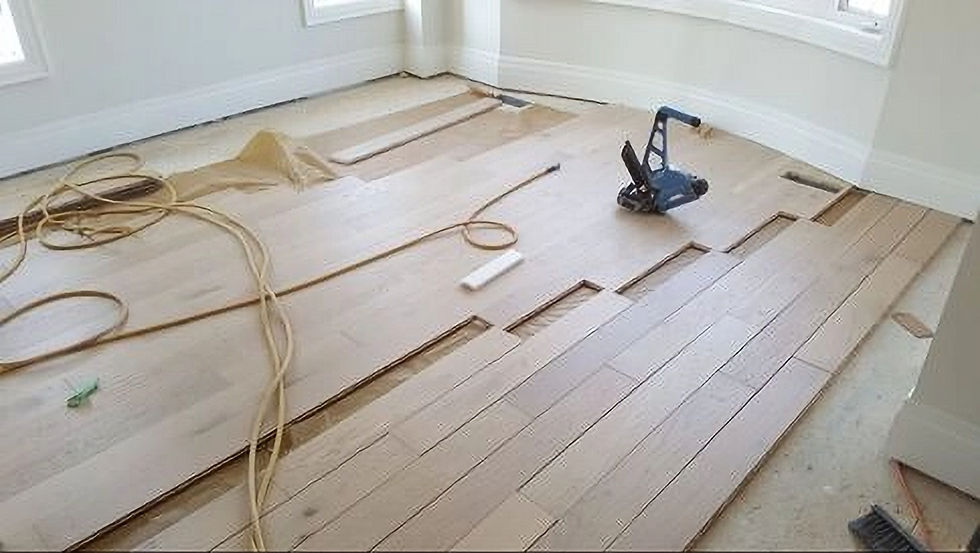
Replacing Damaged Solid Hardwood Flooring Boards
If the existing hardwood flooring is otherwise sound, a contractor may be able to:
Identify the wood species, board width and milling profile.
Remove damaged boards.
Inspect and repair the affected subfloor.
Install compatible replacement hardwood flooring.
Sand and refinish the appropriate continuous area.
This approach can help the repaired section blend with the surrounding flooring.
For example, an older Toronto house with red oak hardwood flooring may be a good candidate for localized board replacement followed by complete room refinishing.
Why Full-Room Refinishing Helps
New wood and existing stained hardwood flooring rarely look identical immediately after installation.
Even when the species matches, differences in age, grain and finish can remain visible.
Sanding and refinishing the entire floor in the room can produce a more consistent colour and sheen than attempting to finish only the replacement boards.
However, exact matching is never guaranteed.
The result still depends on wood species, grade, existing floor condition and the chosen finish.
5. Can Scratches in Hardwood Flooring Be Repaired Without Sanding?
Yes, certain minor scratches can be improved without sanding the entire floor.
The most important distinction is whether the damage affects only the protective finish or extends into the actual wood.
Light Surface Scratches
Minor scratches may respond to:
Compatible hardwood flooring touch-up markers.
Colour-matched repair kits.
Manufacturer-approved maintenance products.
Professional finish repair where appropriate.
These methods can reduce the visibility of small scratches.
However, the repair may not disappear completely under all lighting conditions.
Deep Scratches
Deep scratches can penetrate the protective finish and damage the wood fibres.
A touch-up marker may improve the colour, but it cannot restore missing or crushed wood.
More substantial damage may require filling, board replacement or sanding and refinishing of a larger continuous area.
What About Pet Scratches?
Pet claws can leave marks in the finish or wood surface.
Minor scratches may be manageable with suitable cosmetic repairs.
Numerous deep scratches across an entire room may justify professional hardwood floor refinishing, provided the floor has sufficient usable wood.

6. Can Deep Gouges and Dents Be Fixed?
Deep gouges are different from ordinary surface scratches.
They involve missing, torn or compressed wood fibres.
A small gouge may sometimes be treated with an appropriate filler or repair compound.
However, fillers are primarily cosmetic.
They do not always reproduce the grain, strength or appearance of natural hardwood flooring.
When Board Replacement Makes More Sense
Board replacement may be preferable when:
A large section of wood is missing.
The plank edge is severely chipped.
A concentrated impact has crushed the board.
The damage extends through the finish into the wood.
A filler repair would remain highly visible.
For solid hardwood flooring, replacement boards can sometimes be integrated into the existing floor and refinished with the surrounding area.
For factory-finished engineered hardwood flooring, matching the original product is especially important.
7. Why We Usually Don't Recommend Small Spot-Sanding Repairs
A common request involves sanding and refinishing only a small scratched or stained section.
Although localized finish repairs are technically possible in some circumstances, small spot-sanding repairs often produce visible colour and sheen differences.
This is particularly noticeable on hardwood flooring with an existing stain or factory-applied finish.
Why Spot Sanding Can Look Patchy
The repaired area may have:
A different stain colour.
A different protective finish sheen.
Visible blending lines.
Different wood exposure after sanding.
A finish that reflects light differently.
A repair that looks acceptable from one angle may remain obvious in natural daylight.
For this reason, Parqueteam generally recommends evaluating repairs at the room or continuous-floor level when significant sanding or colour correction is required.
When Is a Small Cosmetic Repair Reasonable?
For a very light scratch, a suitable touch-up product can be reasonable.
The key is setting realistic expectations.
A minor touch-up can make the damage less noticeable without promising an invisible result.
8. What About Water-Damaged Laminate Flooring and Vinyl Plank Flooring?
Although this article focuses on genuine hardwood flooring, Toronto property owners frequently encounter similar problems with laminate flooring and vinyl plank flooring.
Laminate Flooring Water Damage
Conventional laminate flooring contains a wood-fibre core.
When water causes the core to swell, the damage is generally permanent.
Replacing the affected boards is often necessary.
If the original laminate flooring is discontinued, replacing the entire room may be more practical.
Vinyl Plank Flooring Water Damage
Many vinyl plank flooring products have waterproof plank construction.
However, water can still travel beneath the flooring and affect the substrate or adhesive system.
The individual planks may remain usable in some circumstances, but the installation must be evaluated before reuse.
Damaged locking joints or permanently distorted planks generally require replacement.
Glue-down vinyl plank flooring can sometimes allow localized plank replacement, provided suitable matching material is available.
Why Flooring Type Matters
A repair method appropriate for solid hardwood flooring may not work for engineered hardwood flooring, laminate flooring or vinyl plank flooring.
Identifying the actual material is essential before planning repairs.
9. Repair or Replace? How We Evaluate the Damage
When assessing damaged flooring, we focus on the final outcome rather than whether a small repair is physically possible.
Repair May Be Practical When
The damage is limited.
The surrounding flooring is stable.
Compatible replacement boards are available.
The flooring can be refinished.
The subfloor is sound.
The expected repair appearance is acceptable.
Replacement May Be Better When
The flooring has permanent swelling or delamination.
Extensive water damage has spread beneath the surface.
The original product is unavailable.
Matching replacement planks would look noticeably different.
Multiple damaged boards extend through a continuous space.
The existing flooring cannot safely be refinished.
Sometimes repairing a few solid hardwood flooring boards and refinishing the entire room is the most practical solution.
In other situations, particularly with discontinued engineered hardwood flooring in condos, replacing the room may provide a better long-term result.
10. How Much Does Hardwood Flooring Repair Cost in Toronto?
Hardwood flooring repair costs depend on the material, extent of damage and type of work required.
A small cosmetic repair is different from replacing multiple damaged boards, repairing plywood or refinishing an entire room.
Important cost factors include:
Number of damaged planks.
Availability of matching flooring.
Whether the existing floor is glued, nailed or floating.
Underlying subfloor damage.
Removal and disposal requirements.
The need for broader sanding and refinishing.
Access restrictions in Toronto condos.
There is no reliable universal per-square-foot price for every flooring repair.
A proper estimate should be based on inspection and the expected repair method.
When Does Refinishing Become Part of the Cost?
In houses with solid hardwood flooring, repairing damaged boards may be only the first stage.
If new unfinished wood must be blended with the existing floor, the surrounding room may need sanding and refinishing.
That additional work can affect the total project cost.
For extensive damage, we recommend comparing the price of repair and refinishing against full flooring replacement.
11. What Should You Do Immediately After a Flooring Water Leak?
If water damage is discovered, responding appropriately can reduce the extent of the problem.
First, stop the water source if it is safe to do so.
Then:
Remove standing water where safe.
Document the visible damage with photographs.
Contact the appropriate plumbing or restoration professional.
Arrange moisture assessment and drying where needed.
Avoid covering a wet floor with rugs or furniture.
Do not begin sanding until moisture conditions have been evaluated.
Inform condo management where required.
For major flooding, contaminated water or suspected hidden moisture, professional restoration may be necessary before flooring repairs begin.
Flooring replacement should not start while the underlying moisture problem remains unresolved.
12. How to Prevent Future Hardwood Flooring Damage
Although accidents cannot always be avoided, preventive measures can reduce the risk of damage.
Protect Against Scratches
Use appropriate furniture pads and avoid dragging heavy items across the floor.
Sweep regularly to remove sand and grit.
Maintain pet nails and use suitable protective mats where appropriate.
Manage Moisture
Clean ordinary spills promptly.
Inspect plumbing connections around dishwashers, refrigerators and other appliances.
Maintain indoor temperature and relative humidity within the flooring manufacturer's recommendations.
Keep Spare Flooring
Retain leftover planks after installation.
Store the product information and specifications with your renovation records.
Address Minor Problems Early
Loose planks, changing gaps or localized surface damage should be assessed before the problem becomes more extensive.

Frequently Asked Questions About Hardwood Flooring Repairs
Can water-damaged hardwood flooring be repaired?
Yes, depending on the severity and type of damage. Mild cupping may improve after appropriate drying, while permanently damaged boards may need replacement. Solid hardwood flooring can sometimes be repaired and refinished without replacing the entire floor.
Can only a few damaged flooring planks be replaced?
Yes, if compatible replacement planks are available and the installation allows it. Exact product matching is especially important with factory-finished engineered hardwood flooring, laminate flooring and vinyl plank flooring.
Can scratches in hardwood flooring be fixed without sanding?
Minor scratches may be made less noticeable with suitable touch-up markers or repair products. Deep scratches that damage the wood may require more substantial repairs.
Can engineered hardwood flooring be repaired after water damage?
Some isolated damage can be repaired by replacing affected boards. However, permanently swollen or delaminated engineered hardwood flooring generally cannot be restored through sanding.
Why is flooring repair harder in Toronto condos?
Many condos have factory-finished flooring installed years earlier. The original brand, colour or locking system may be discontinued, making compatible plank replacement difficult.
Can a hardwood floor be sanded in only one small spot?
Small spot sanding can create visible differences in colour and sheen. When significant sanding is required, refinishing a larger continuous area often produces a more consistent result.
Is water-damaged laminate flooring repairable?
Conventional laminate flooring with a permanently swollen core generally requires plank replacement. If matching planks are unavailable, a larger area may need replacement.
Should hardwood flooring be sanded immediately after water damage?
No. The moisture source must first be corrected, and the flooring and substrate should be assessed and allowed to stabilize. Sanding a still-cupped, wet floor can create additional problems.
How do I know if my hardwood flooring needs replacement?
Permanent swelling, buckling, delamination, severe staining, extensive hidden moisture damage and unavailable matching products are common reasons to consider replacement.
Final Thoughts: What Hardwood Flooring Damage Can Actually Be Fixed?
Not every damaged hardwood floor requires complete replacement, but not every problem can be solved with a small touch-up.
Minor scratches can often be improved cosmetically.
Solid hardwood flooring in Toronto houses may allow damaged boards to be replaced and the surrounding floor refinished for a consistent result.
Engineered hardwood flooring, laminate flooring and vinyl plank flooring repairs depend heavily on the availability of matching planks.
With water damage, the first priority is correcting the moisture problem and assessing the condition of the flooring and subfloor.
The most effective repair is one that addresses the underlying damage and produces a result that makes sense for the entire space.
Professional Hardwood Flooring Repair in Toronto
At Parqueteam Hardwood Flooring, we provide hardwood flooring repairs, damaged plank replacement and dustless hardwood floor refinishing throughout Toronto and the Greater Toronto Area.
We assess damaged solid hardwood flooring, engineered hardwood flooring, laminate flooring and vinyl plank flooring to determine which repair options are practical.
Whether you have water-damaged flooring in a Toronto condo, deep scratches in a house or damaged boards after a renovation, our team can evaluate the material and recommend an appropriate solution.
Parqueteam maintains WSIB coverage and liability insurance.


Comments