
Best Flooring for Condos in Toronto: Engineered Hardwood vs. Vinyl vs. Laminate
Choosing the best flooring for a Toronto condo is different from selecting flooring for a detached house.
Most condominium renovations involve concrete subfloors, building-specific acoustic requirements, and restrictions on approved flooring materials and installation methods.
But what type of flooring is best for condos?
For most Toronto condo owners, the strongest choices are engineered hardwood flooring, vinyl plank flooring and laminate flooring.
Engineered hardwood flooring is an excellent option for homeowners who want a genuine wood surface and premium appearance. Vinyl plank flooring is a practical choice for pets, rental properties and households concerned about spills. Laminate flooring offers an affordable wood-look alternative for dry living spaces.
However, the best choice depends on your lifestyle, renovation budget, subfloor condition and condominium building requirements.
This guide compares the three flooring options to help Toronto condo owners make an informed decision.

Best Flooring Options for Toronto Condos: Quick Comparison
Feature | Engineered Hardwood Flooring | Vinyl Plank Flooring | Laminate Flooring |
Appearance | Genuine hardwood surface | Realistic wood-look designs | Realistic wood-look designs |
Water resistance | Sensitive to prolonged moisture | Many products have waterproof planks | Product-dependent; prolonged moisture can cause damage |
Scratch resistance | Depends on species and finish | Depends on product and wear layer | Often good abrasion resistance |
Cost | Generally higher | Moderate, product-dependent | Often economical |
Installation over concrete | Many approved methods available | Many approved methods available | Floating systems commonly used |
Refinishing potential | Possible for certain products | Not conventionally refinishable | Not conventionally refinishable |
Condo acoustic approval | Requires suitable assembly | Requires suitable assembly | Requires suitable assembly |
No flooring type automatically satisfies every Toronto condo building's regulations. Approval depends on the complete installation system.
1. Engineered Hardwood Flooring: Best for a Premium Real-Wood Appearance
For Toronto homeowners who want the appearance and feel of genuine hardwood flooring, engineered hardwood flooring is often the strongest option.
Engineered hardwood flooring has a genuine hardwood surface bonded to a supporting core.
Its layered construction generally provides greater dimensional stability than traditional solid hardwood flooring, making many engineered products suitable for approved installations over concrete.
Advantages of Engineered Hardwood Flooring in Condos
Authentic appearance: Engineered hardwood flooring provides genuine wood grain and natural variation rather than a printed imitation.
Design flexibility: Popular choices include natural white oak, European oak, warm brown finishes and wider planks.
Installation options: Depending on the product and condo requirements, engineered hardwood flooring may be installed using approved floating, glue-down or double glue-down systems.
Potential refinishing: Some engineered hardwood flooring products can be refinished, depending on the hardwood wear-layer thickness and construction.
Disadvantages to Consider
Engineered hardwood flooring generally costs more than many laminate flooring and vinyl plank flooring products.
It is also not waterproof. Prolonged spills, appliance leaks and significant moisture exposure can damage the wood surface or supporting layers.
Engineered hardwood flooring can scratch and dent, so households with pets or frequently moved furniture should consider the finish and wood species carefully.
Who Should Choose Engineered Hardwood Flooring?
Engineered hardwood flooring is particularly worth considering for:
Owner-occupied condos.
Premium condo renovations.
Living rooms and bedrooms.
Homeowners who prefer natural wood materials.
Long-term renovations where appearance is a priority.
For many Toronto condo owners, engineered hardwood flooring offers a compelling combination of appearance, construction and installation versatility.
2. Vinyl Plank Flooring: Best for Pets, Rentals and Everyday Practicality
Vinyl plank flooring is another excellent option for Toronto condominiums.
Modern vinyl plank flooring is available in realistic oak-inspired colours, textured finishes and different plank dimensions.
Many products resist everyday water exposure better than conventional hardwood flooring and laminate flooring.
Advantages of Vinyl Plank Flooring in Condos
Water-resistant construction: Many vinyl plank flooring products have waterproof plank construction, making them useful in homes where everyday spills are common.
Practical maintenance: Regular sweeping and manufacturer-approved cleaning are generally straightforward.
Rental suitability: Commercially or residentially rated vinyl plank flooring products can be practical for investment condos and tenant turnover.
Design choices: Vinyl plank flooring is available in natural oak, warm brown, grey and other wood-look finishes.
Installation flexibility: Both click-lock and glue-down vinyl plank flooring systems may be suitable for condos, subject to product and building approval.
Important Limitations
Waterproof vinyl plank flooring does not make the entire floor assembly waterproof.
Water can still affect the concrete substrate, underlayment, adhesives and surrounding building materials.
Product quality also varies significantly. Cheap click-lock vinyl plank flooring with weak locking joints may perform poorly over uneven subfloors.
For click-lock vinyl plank flooring, Parqueteam generally prefers well-constructed 8 mm products when appropriate, although quality 7 mm flooring can also be suitable.
For glue-down vinyl plank flooring, thinner 3 mm and 5 mm products can be reliable because they use a different installation system.
Click-Lock or Glue-Down Vinyl Plank Flooring for Condos?
Click-lock vinyl plank flooring can be a practical solution where the building permits floating flooring and the approved acoustic assembly is compatible.
Glue-down vinyl plank flooring may offer advantages in certain layouts, but some condo buildings require an approved acoustic membrane beneath it.
Neither installation method automatically satisfies condominium sound-control requirements.
Who Should Choose Vinyl Plank Flooring?
Vinyl plank flooring is especially attractive for:
Rental and investment condos.
Households with pets.
Busy living areas and hallways.
Budget-conscious renovations.
Homeowners prioritizing practical cleaning and spill resistance.
3. Laminate Flooring: Best for Budget-Conscious Condo Renovations
Laminate flooring provides a wood-look appearance without the cost of genuine hardwood flooring.
Many modern laminate flooring products feature textured surfaces, convincing wood grain and durable protective layers.
For Toronto homeowners renovating a bedroom, living room or investment property, laminate flooring can provide an attractive result within a controlled budget.
Advantages of Laminate Flooring
Affordability: Many laminate flooring products cost less than premium engineered hardwood flooring.
Surface abrasion resistance: Appropriate laminate flooring products can perform well against everyday surface wear.
Design variety: Laminate flooring is available in natural oak, light beige, grey and traditional brown finishes.
Floating installation: Many products use click-lock systems that can be installed over approved acoustic underlayment.
Disadvantages of Laminate Flooring
Conventional laminate flooring cores can swell or become damaged when exposed to prolonged moisture.
Although some manufacturers offer enhanced water-resistant products, not every laminate flooring system provides the same protection.
Laminate flooring cannot be sanded and refinished like suitable genuine hardwood flooring.
Damaged planks generally require replacement.
Who Should Choose Laminate Flooring?
Laminate flooring can be a suitable option for:
Condo bedrooms.
Dry living rooms.
Budget renovations.
Selected rental units.
Homeowners seeking an economical wood-look surface.
For kitchens, areas with frequent spills or households expecting substantial moisture exposure, an appropriate vinyl plank flooring product may be more practical.

4. Is Solid Hardwood Flooring a Good Choice for Toronto Condos?
Solid hardwood flooring provides a traditional genuine wood surface and substantial potential for future refinishing.
However, it is often less practical than engineered hardwood flooring for concrete-based condo renovations.
Solid hardwood flooring commonly uses fastening systems designed for suitable wood-based subfloors.
Installing these systems over concrete may require additional construction or a specially approved method.
That can increase floor height and create complications at doors, transitions and existing fixtures.
Certain solid hardwood flooring systems may be technically possible in specific condos, but building approval and manufacturer requirements must be considered.
For most condo owners who want genuine hardwood flooring, engineered hardwood flooring is the more practical starting point.
5. Which Flooring Is Best for Different Condo Owners?
The most useful way to choose condo flooring is to consider how the property will be used.
Best Flooring for an Owner-Occupied Condo
Recommended: Engineered hardwood flooring
For homeowners planning to stay in their condo for many years, engineered hardwood flooring can provide a premium natural appearance.
Choose a quality product with an appropriate wear layer and an installation system approved for the building.
Best Flooring for a Rental or Investment Condo
Recommended: Vinyl plank flooring
Vinyl plank flooring offers practical advantages for tenant turnover, routine cleaning and everyday spill exposure.
A suitable commercial- or residential-rated product may help reduce maintenance concerns.
Best Flooring for Condo Owners With Pets
Recommended: Quality vinyl plank flooring, with suitable laminate flooring also worth considering
A product's scratch and indentation performance matters more than the flooring category alone.
No commonly used flooring material is completely scratchproof.
Best Flooring for Condo Bedrooms on a Budget
Recommended: Laminate flooring
Laminate flooring can provide an attractive wood-look finish at a relatively accessible price.
It is particularly appropriate for dry, climate-controlled rooms.
Best Flooring for Open-Concept Condos
Recommended: Engineered hardwood flooring or vinyl plank flooring
Both can create a continuous visual appearance across living and dining spaces.
The final choice should depend on design preferences, budget, maintenance expectations and approved installation methods.
6. What Flooring Can Be Installed Over Concrete Condo Subfloors?
Many Toronto condominiums use concrete structural slabs beneath the finished flooring.
This affects the installation method and the materials that can be used.
Engineered hardwood flooring may be suitable for approved glue-down, double glue-down or floating installations.
Vinyl plank flooring may use a compatible floating or glue-down system.
Laminate flooring typically uses a manufacturer-approved floating installation method.
Regardless of the product, concrete must meet the relevant moisture, flatness and surface-condition requirements.
Even relatively new condo units can have concrete irregularities requiring preparation before flooring installation.
The flooring product, substrate and installation method should be evaluated together.
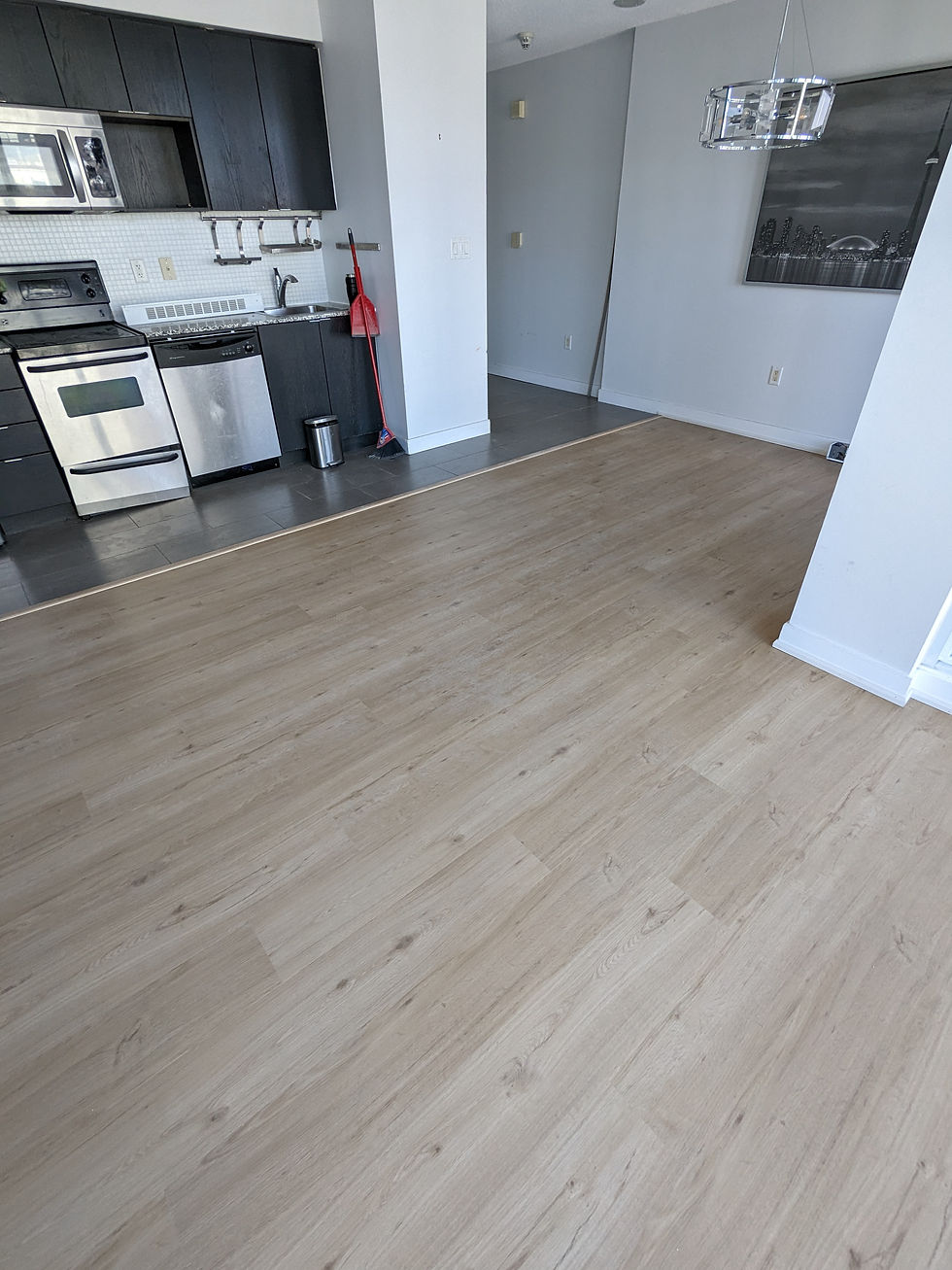
7. Do Toronto Condos Require Soundproof Flooring Underlayment?
Many Toronto condominium buildings require an approved acoustic flooring system when replacing existing flooring.
Hard-surface flooring can transmit impact noise, including footsteps and dropped objects, to neighbouring units.
Building management may request documentation relating to:
Impact Insulation Class (IIC).
Sound Transmission Class (STC).
Approved acoustic underlayment.
Flooring product specifications.
The complete tested flooring assembly.
There is no single acoustic rating that can be assumed to satisfy every Toronto condominium.
Requirements vary between buildings, and the performance of a complete floor-and-ceiling assembly cannot be determined from the underlayment alone.
Some floating flooring products have attached padding, but that does not automatically mean they meet the building's acoustic requirements.
Before purchasing flooring, request the condominium's renovation guidelines and confirm which materials and assemblies are approved.
8. How Much Does Condo Flooring Cost in Toronto?
Condo flooring installation costs vary with the selected product, preparation requirements and installation method.
At Parqueteam Hardwood Flooring, the following pricing provides a useful reference.
Flooring Cost | Typical Parqueteam Rate |
Engineered hardwood flooring materials | $4.99–$11.99/sq. ft. |
Straight-plank engineered hardwood flooring installation labour | $2.50–$3.50/sq. ft. |
Glue-down engineered hardwood flooring labour | $3.00–$4.50/sq. ft. |
Glue-down vinyl plank flooring materials | $3.99–$4.99/sq. ft. |
Straight-pattern glue-down vinyl plank flooring labour | $2.50–$3.50/sq. ft. |
These are starting ranges, not complete condo renovation quotations.
Acoustic underlayment, adhesives, concrete preparation, old flooring removal, transitions and applicable taxes may increase the project total.
Laminate flooring requires a product-specific estimate.
For a more comprehensive breakdown across flooring types, see our Toronto flooring cost guide.
9. Common Mistakes When Choosing Condo Flooring
Even attractive flooring products can create problems when selected without considering the building and the installation conditions.
Buying Flooring Before Checking Condo Rules
A homeowner may purchase engineered hardwood flooring or vinyl plank flooring that the condominium corporation does not approve.
Always review the building's requirements first.
Assuming All Underlayments Provide Adequate Soundproofing
A generic acoustic rating or attached pad does not automatically satisfy every building's requirements.
Check the documentation for the complete approved flooring system.
Ignoring Concrete Subfloor Preparation
Uneven concrete can contribute to locking-joint problems, visible surface irregularities or poor adhesive bonding.
Subfloor preparation is part of achieving a reliable installation.
Choosing Flooring Based Only on Thickness
Thicker flooring is not always better.
Construction quality, wear-layer performance, joint design and installation compatibility are equally important.
Selecting Flooring Only by Price
The cheapest flooring product may not provide the best value if it wears prematurely or requires frequent replacement.
Choose a product appropriate for the condo's intended use and expected conditions.

Frequently Asked Questions About the Best Flooring for Condos
What is the best flooring for condos in Toronto?
Engineered hardwood flooring is an excellent choice for homeowners prioritizing genuine wood appearance. Vinyl plank flooring is practical for pets, rentals and everyday spills. Laminate flooring offers an economical option for dry living spaces.
Is engineered hardwood flooring better than vinyl plank flooring for condos?
Engineered hardwood flooring offers a genuine hardwood surface and potential refinishing benefits. Vinyl plank flooring often provides better everyday water resistance and easier maintenance. The better choice depends on the homeowner's priorities and building requirements.
Is vinyl plank flooring better than laminate flooring for condos?
Vinyl plank flooring is often preferable where spills or moisture exposure are concerns. Laminate flooring can offer good surface wear resistance and value in dry rooms.
Can engineered hardwood flooring be installed in a Toronto condo?
Yes, when the selected engineered hardwood flooring product and installation system meet the condominium's requirements. Many products are compatible with properly prepared concrete subfloors.
Does condo flooring need special underlayment?
Many Toronto condo buildings require approved acoustic underlayment or a documented sound-control flooring assembly. The exact requirement varies by building.
What flooring is best for a condo rental property?
Suitable vinyl plank flooring is often a practical choice because of its maintenance characteristics, moisture resistance and availability of durable products.
Can I replace condo carpet with hardwood flooring?
Often, yes, but changing from carpet to a hard-surface product may trigger acoustic requirements or renovation approval conditions. Confirm the building's rules before purchasing flooring.
Which condo flooring increases resale value the most?
There is no guaranteed resale return for a particular flooring type. Well-installed engineered hardwood flooring may appeal to buyers seeking genuine wood, while quality vinyl plank flooring can also improve a unit's presentation and practicality.
Final Verdict: Which Flooring Is Best for Your Toronto Condo?
For most Toronto condos, choosing between engineered hardwood flooring, vinyl plank flooring and laminate flooring comes down to three priorities.
Choose engineered hardwood flooring if genuine wood appearance and premium interior design are most important.
Choose vinyl plank flooring if moisture resistance, practical maintenance and rental-property suitability are your priorities.
Choose laminate flooring if you want an attractive wood-look finish for a dry living space at a more economical price.
Whichever flooring material you choose, confirm that the complete installation system is suitable for your concrete subfloor and complies with condominium regulations.
Need Professional Condo Flooring Installation in Toronto?
At Parqueteam Hardwood Flooring, we provide professional condo flooring installation throughout Toronto and the Greater Toronto Area.
Our services include engineered hardwood flooring installation, vinyl plank flooring installation, laminate flooring installation, old flooring removal and appropriate subfloor preparation.
We can help assess the existing floor and evaluate installation options based on your selected product and building requirements.
Parqueteam maintains WSIB coverage and liability insurance.


Comments